
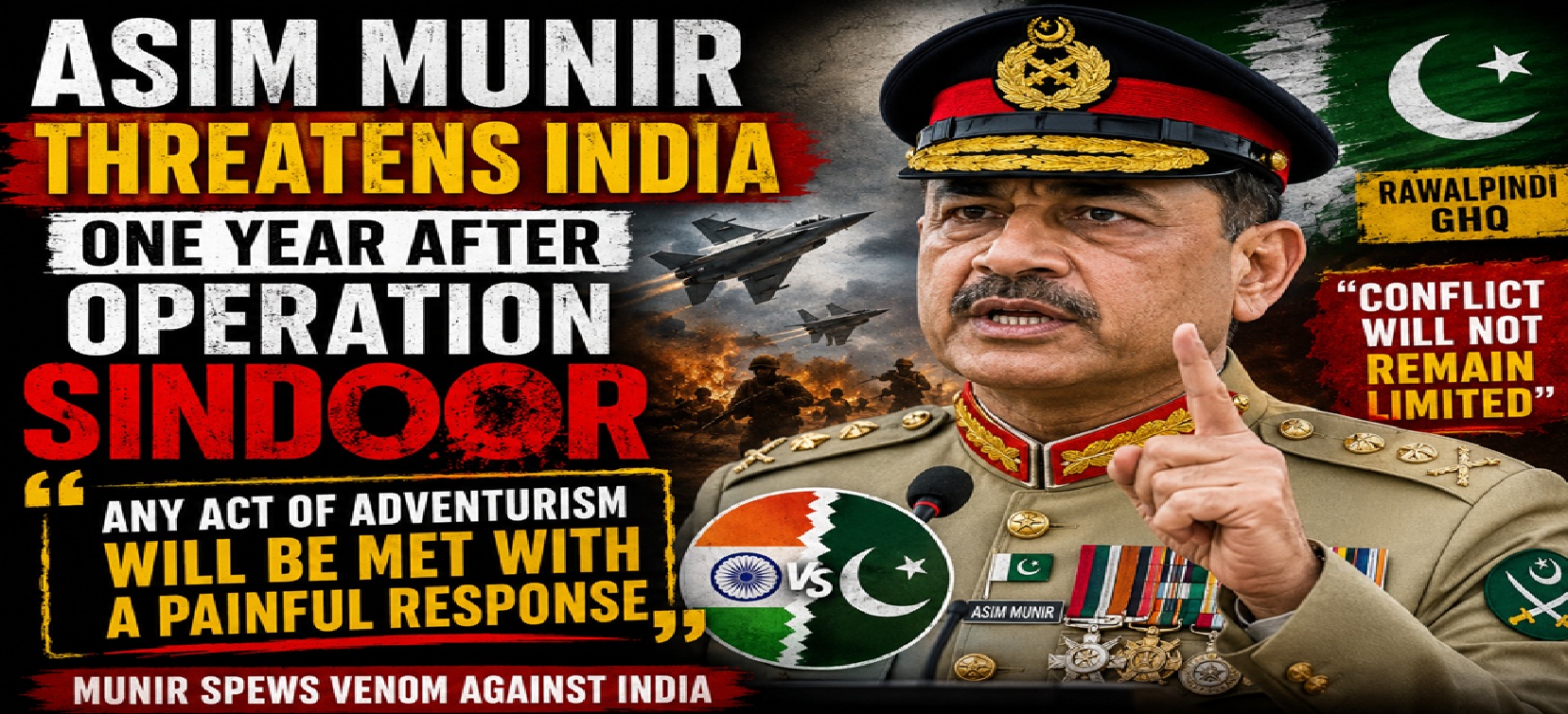
Pakistan Army Chief Asim Munir Threatens India One Year After ‘Operation Sindoor
Pakistan Army Chief Asim Munir Threatens India One Year After ‘Operation Sindoor
Pakistan Army Chief Asim Munir Threatens India: One year after India’s ‘Operation Sindoor,’ Pakistan Army Chief Asim Munir has issued fresh threats against India from Rawalpindi. Here’s an in-depth analysis of the speech, the strategic messaging behind it, and what it means for India-Pakistan relations.
Amit Kaul – For Digital Desk, Bengaluru: May 11, 2026 – Tensions between India and Pakistan have once again intensified after Pakistan Army Chief Asim Munir issued a sharp warning against India during an address at the General Headquarters (GHQ) in Rawalpindi.
Speaking almost exactly one year after the controversial and highly debated “Operation Sindoor,” Munir declared that any future “act of adventurism” against Pakistan would invite a “dangerous, far-reaching, and painful” response.
The remarks, widely reported by Dawn, are being interpreted by strategic analysts as a deliberate escalation in military rhetoric aimed at reinforcing Pakistan’s deterrence posture while simultaneously shaping domestic political narratives.
More importantly, the speech reflects how the memory of last year’s military confrontation continues to dominate the security calculations of both nuclear-armed neighbors.
Pakistan Army Chief Asim Munir Threatens India: The Shadow of ‘Operation Sindoor’
Although details surrounding “Operation Sindoor” remain deeply contested between the two sides, the operation marked one of the most serious India-Pakistan military confrontations in recent years.
Indian strategic circles projected the operation as a calibrated military success that demonstrated New Delhi’s willingness to impose costs on cross-border threats without triggering uncontrolled escalation.
Pakistan, however, has consistently attempted to portray the conflict differently.
In his latest speech, Asim Munir claimed that Pakistan’s response strategy during the May 2025 conflict proved “superior” and effectively countered India’s military objectives.
By publicly revisiting the episode one year later, Pakistan’s military leadership appears intent on reshaping the narrative surrounding the confrontation—particularly for domestic audiences.
Military analysts often note that post-conflict narrative control is almost as important as battlefield outcomes themselves. In South Asia’s hyper-nationalized political environment, perception management plays a central role in sustaining strategic credibility.
https://digitalamitkaul.online/iran-hoot-torpedo-supercavitation-us-navy-threat-analysis/
Strategic Messaging Behind Munir’s Speech
Munir’s remarks were not merely emotional rhetoric; they carried multiple layers of strategic messaging.
1. Reinforcing Nuclear Deterrence
By warning that future conflict “will not remain limited,” Munir was signaling Pakistan’s long-standing doctrine of escalation unpredictability.
Pakistan has historically attempted to deter Indian conventional military operations by suggesting that even limited engagements could spiral into broader confrontation.
This messaging is designed to discourage India from considering future cross-border military actions similar to surgical strikes or precision operations.
2. Domestic Political Consolidation
Pakistan’s military establishment remains deeply influential within the country’s political structure. Speeches emphasizing national sovereignty, external threats, and military resilience often serve domestic political purposes as well.
At a time when Pakistan continues to face economic instability, political fragmentation, and internal security challenges, anti-India rhetoric can help consolidate nationalist sentiment.
3. International Signaling
Munir’s statements also appear directed toward international audiences.
By framing the confrontation as a dangerous ideological conflict between two nuclear powers, Pakistan seeks to project itself as a responsible state facing an allegedly aggressive regional adversary.
This narrative aims to attract diplomatic attention and reinforce international concerns regarding escalation risks in South Asia.
Pakistan Army Chief Asim Munir Threatens India: The ‘False Flag’ Allegation Strategy
One of the most controversial aspects of Munir’s speech was his decision to label major terror-related incidents—including the attacks of 2001, 2008, 2016, and 2019—as “false flag” operations allegedly orchestrated by India.
These claims have long been rejected by India and remain highly contentious internationally.
The reference to these events was politically significant because it attempted to challenge the legitimacy of India’s security narrative over the past two decades.
The 2001 Parliament attack, the 2008 Mumbai terror attacks, the Uri attack in 2016, and the Pulwama attack in 2019 fundamentally shaped India’s counterterrorism and military response doctrine.
By disputing the authenticity of those incidents, Pakistan’s military leadership appears to be attempting to undermine India’s justification for retaliatory operations.
Nonetheless, the terror infrastructure located in Pakistan has been accused by Indian officials and security professionals of being involved in numerous attacks against India.
Ideological Framing of the Conflict
Another striking feature of Munir’s address was his description of the India-Pakistan confrontation as a “decisive battle between two ideologies.”
This ideological framing is significant because it shifts the narrative away from conventional geopolitical rivalry toward a broader civilizational and identity-based confrontation.
Security experts warn that ideological militarization often increases long-term instability because it reduces space for diplomatic compromise.
Historically, periods of heightened ideological rhetoric between India and Pakistan have coincided with elevated border tensions, intensified information warfare, and increased strategic mistrust.
Pakistan Army Chief Asim Munir Threatens India: India’s Likely Strategic Response
India has not officially responded in detail to Munir’s latest remarks, but strategic observers believe New Delhi is unlikely to react rhetorically.
Over recent years, India’s security posture has increasingly emphasized strategic restraint combined with operational readiness.
Indian policymakers have consistently maintained that cross-border terrorism and threats to national sovereignty will receive firm responses while avoiding uncontrolled escalation.
Experts believe India will continue focusing on strengthening border infrastructure, intelligence capabilities, precision warfare systems, and diplomatic engagement with global partners.
Regional Stability Under Pressure
The renewed escalation in rhetoric comes at a fragile moment for South Asian stability.
Both India and Pakistan remain nuclear powers with unresolved territorial disputes, deep historical hostility, and recurring military flashpoints.
Even when direct conflict is avoided, aggressive military rhetoric contributes to strategic instability by increasing public pressure, reducing diplomatic flexibility, and heightening risks of miscalculation.
Moreover, in the era of cyber warfare, drone technology, and rapid information dissemination, future confrontations may unfold in far more unpredictable ways than previous conflicts.
A Reminder of Persistent Hostility
Asim Munir’s speech ultimately reflects a deeper reality: despite intermittent diplomatic efforts, India-Pakistan relations remain structurally adversarial.
One year after “Operation Sindoor,” the rhetoric emerging from Rawalpindi suggests that both sides continue to view each other primarily through a security lens rather than a diplomatic one.
Whether the coming years witness further escalation or cautious stability will depend not only on military preparedness but also on political leadership, regional diplomacy, and the ability of both nations to prevent crises from spiraling into confrontation.
https://aamnewsnetwork.com/israel-secret-military-base-iraq-iran-wsj-report/
For now, however, Munir’s remarks serve as a stark reminder that the India-Pakistan rivalry remains one of the world’s most volatile geopolitical fault lines.
Author Bio
Amit Kaul is a professional content writer and digital news strategist based in Bengaluru (India). With over a decade of experience covering transportation, technology, and travel, Amit specializes in creating SEO-optimized, engaging news content for digital platforms. He focuses on in-depth reporting, trend analysis, and reader-friendly storytelling, ensuring articles reach a global audience effectively.



Pingback: Has the UAE Quietly Joined the War Against Iran? Wall Street Journal Report Raises Major Questions - ANN
Pingback: Attack on Indian Ship Near Hormuz Sparks Diplomatic Alarm; MEA Says “This Will Not Be Tolerated” - ANN