
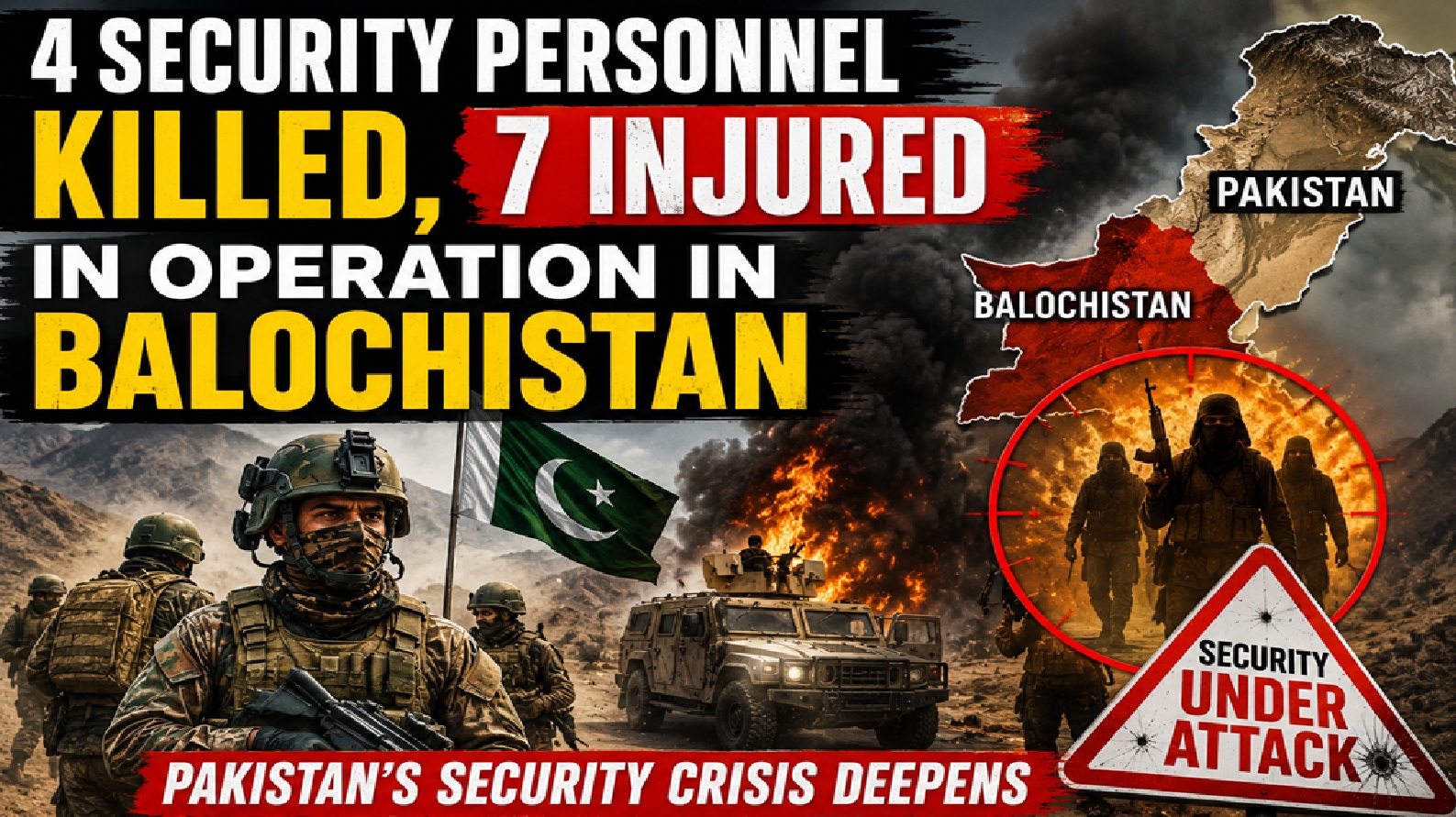
Pakistan Faces Renewed Security Crisis: 4 Personnel Killed, Multiple Injured in Balochistan Intelligence Operation
Pakistan Faces Renewed Security Crisis: 4 Personnel Killed, Multiple Injured in Balochistan Intelligence Operation
Pakistan Faces Renewed Security Crisis: An intelligence-based operation in Balochistan resulted in the deaths of four Pakistani security personnel and the injuries of seven. The latest violence highlights Pakistan’s growing internal security crisis amid escalating militant attacks in Balochistan and Khyber Pakhtunkhwa.
A Deadly Operation in Balochistan Highlights Pakistan’s Growing Security Challenge
Amit Kaul – For Digital Desk, Bengaluru: May 26, 2026 – Pakistan’s fragile internal security environment has once again come under the spotlight after four security personnel were killed and seven others injured during an intelligence-based operation in the restive province of Balochistan.
Security forces began the operation in the Kuchlak and Nohsar districts on Saturday, according to Balochistan government spokesperson Shahid Rind, following intelligence reports of militant activity in the area.
Authorities also claimed that at least nine attackers were killed during the confrontation, although independent verification of the figures remains difficult due to the remote and conflict-sensitive nature of the area.
The injured security personnel are currently undergoing treatment in Quetta, the provincial capital.
The latest clash underscores the deteriorating security situation in Pakistan’s western provinces, where militant violence, separatist insurgency, and extremist attacks continue to challenge state authority despite repeated military operations.
https://digitalamitkaul.online/pahalgam-terror-attack-nia-gopro-camera-let-china-pakistan/
Pakistan Faces Renewed Security Crisis: Why Balochistan Remains Pakistan’s Most Sensitive Province
Balochistan, Pakistan’s largest but least populated province, has remained a center of insurgency and armed conflict for decades.
The province is strategically crucial because of:
- Its proximity to Afghanistan and Iran
- The presence of key China-Pakistan Economic Corridor (CPEC) projects
- Gwadar Port’s geopolitical importance
- Rich natural resources, including gas and minerals
However, claims of economic neglect, political marginalization, enforced disappearances, and a strong military presence have long existed in the area.
Several separatist groups operate in Balochistan, accusing Islamabad of exploiting the province’s resources while denying locals adequate political and economic rights.
To destroy extremist networks operating in isolated mountainous areas, Pakistan’s security services have stepped up intelligence-based operations in recent years. Despite these efforts, attacks targeting security personnel, infrastructure, and Chinese-linked projects continue to occur frequently.
Pakistan Faces Renewed Security Crisis: Intelligence-Based Operations Becoming Central to Pakistan’s Security Strategy
The operation in Kuchlak and Nohsar reflects Pakistan’s increasing reliance on intelligence-based operations (IBOs) rather than large-scale conventional military campaigns.
These operations are generally launched following surveillance or actionable intelligence about militant hideouts, movement, or planned attacks.
Security analysts note that intelligence-driven missions are intended to minimize civilian casualties while targeting insurgent leadership and operational cells more precisely. However, such operations also expose security personnel to ambushes and close-quarter combat in difficult terrain.
The reported deaths of four security personnel indicate that militant groups operating in Balochistan continue to possess operational capability and local knowledge of the region.
Rising Violence Beyond Balochistan Raises Alarm
Balochistan is not the only place where security issues exist.
In another violent incident on Sunday, heavily armed attackers ambushed members of a local peace committee in the Kulachi Tehsil area of Dera Ismail Khan district in Khyber Pakhtunkhwa province.
According to reports, four committee members were killed during the attack, while one individual was abducted by the assailants.
No organization has officially claimed responsibility so far.
The attack is significant because peace committees in Pakistan’s northwestern regions have historically assisted local authorities in resisting militant influence and maintaining intelligence coordination at the grassroots level.
Targeting such committees often serves multiple purposes for militant groups:
- Weakening local resistance networks
- Creating fear among communities
- Undermining cooperation with security agencies
- Expanding influence in vulnerable districts
The killing of peace committee members also demonstrates that militant groups remain capable of striking beyond isolated mountainous areas.
Pakistan’s Multi-Front Security Crisis Deepens
Pakistan is currently facing a complex and evolving internal security challenge involving multiple armed actors operating across different regions.
These include:
- Separatist insurgents in Balochistan
- Tehreek-e-Taliban Pakistan (TTP)-linked militants
- Sectarian extremist organizations
- Cross-border militant networks
- Localized armed factions
The success of Pakistan’s long-term counterterrorism strategy has come under scrutiny due to the recent increase in assaults.
Following the Taliban’s return to power in neighboring Afghanistan in 2021, Pakistan has repeatedly expressed concern over militant safe havens and cross-border movement of armed fighters.
The Taliban government in Kabul disputes Islamabad’s accusation that several anti-Pakistan militant groups are exploiting Afghan territory to plan strikes.
https://aamnewsnetwork.com/attack-on-indian-ship-near-hormuz-mea-response-oman-iran-brics/
Pakistan Faces Renewed Security Crisis: Strategic Implications for China-Pakistan Economic Corridor
The renewed instability in Balochistan also carries major implications for the China-Pakistan Economic Corridor (CPEC), one of the flagship infrastructure initiatives linked to China’s Belt and Road Initiative.
Militant groups in Balochistan have repeatedly targeted projects associated with Chinese investments, arguing that local communities are excluded from the economic benefits.
Pakistan’s military and political leadership are under more pressure due to security risks to CPEC projects, particularly as Islamabad looks to foreign investment to boost its faltering economy.
Any prolonged deterioration in security could affect investor confidence, infrastructure timelines, and Pakistan’s broader economic recovery plans.
Security Operations Likely to Intensify
Experts believe Pakistan’s security establishment is likely to intensify intelligence-led operations in both Balochistan and Khyber Pakhtunkhwa following the recent attacks.
However, analysts argue that military action alone may not fully resolve the crisis.
Many observers believe long-term stability will require:
- Political reconciliation
- Economic development
- Greater provincial inclusion
- Counter-radicalization measures
- Strengthened local governance
- Improved border security coordination
Without addressing the underlying political and socio-economic grievances fueling unrest, security operations may only provide temporary containment rather than lasting peace.
For now, the deaths of security personnel and local peace committee members serve as another stark reminder that Pakistan continues to confront one of the region’s most complicated and persistent internal security battles.
Author Bio
Amit Kaul is a professional content writer and digital news strategist based in Bengaluru (India). With over a decade of experience covering transportation, technology, and travel, Amit specializes in creating SEO-optimized, engaging news content for digital platforms. He focuses on in-depth reporting, trend analysis, and reader-friendly storytelling, ensuring articles reach a global audience effectively.



Pingback: Major Israeli Military Operation in Hezbollah Stronghold: Why the Capture of Beaufort Castle Could Reshape the Lebanon Conflict - DNN
Pingback: U.S. Strikes Iranian Radar and Drone Sites as IRGC Hits American Base | Is the Middle East on the Brink of a Wider Conflict? - ANN
Pingback: USA: Bomb Threat at California Chase Bank Triggers Major Security Response - DNN