
Has the UAE Quietly Joined the War Against Iran? Wall Street Journal Report Raises Major Questions
Has the UAE Quietly Joined the War Against Iran? Wall Street Journal Report Raises Major Questions
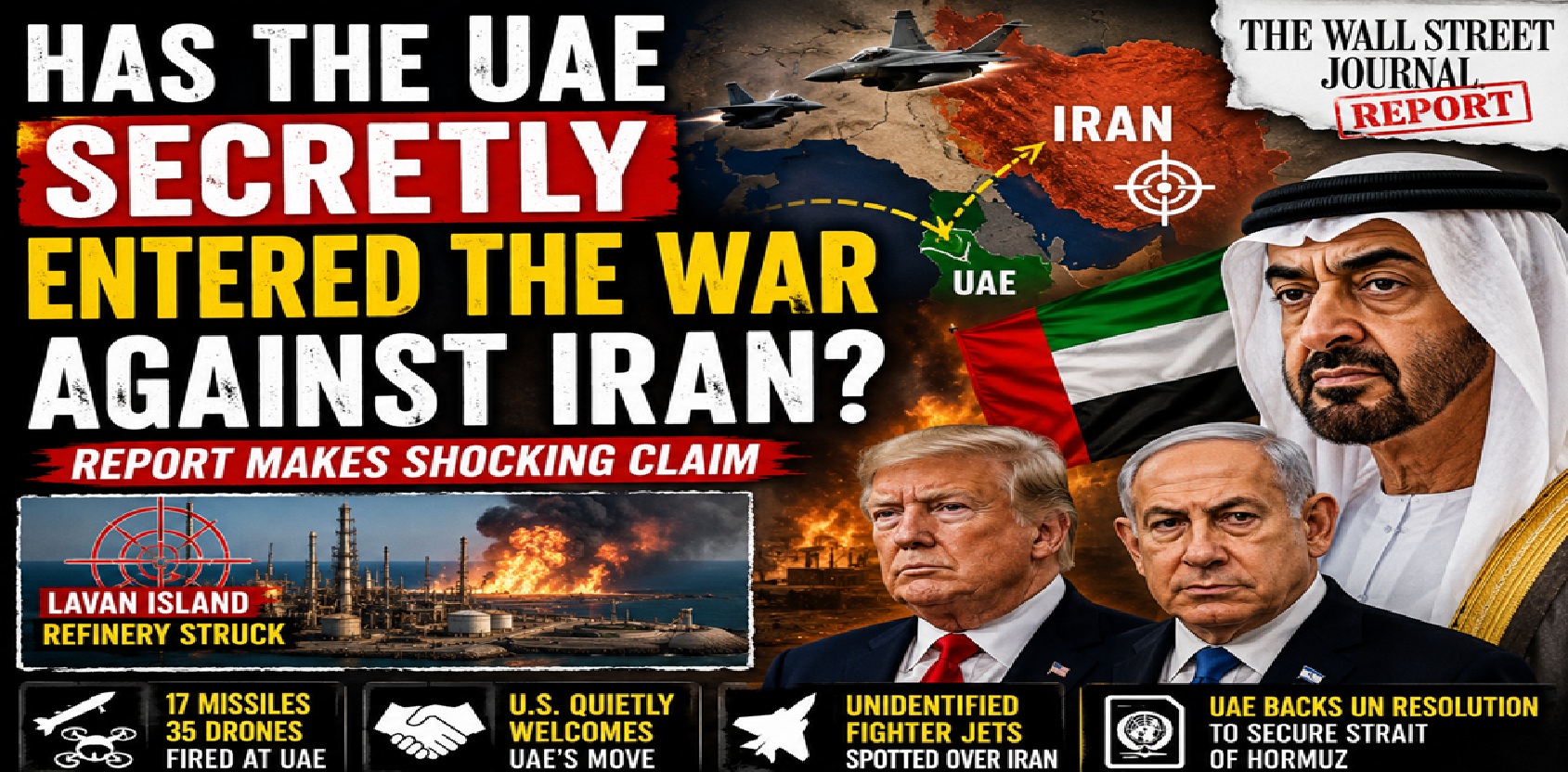
Has the UAE Quietly Joined the War Against Iran: A Wall Street Journal report claims the UAE secretly carried out strikes against Iran during the recent Middle East conflict. Here’s an in-depth analysis of the allegations, the geopolitical implications, and how Gulf dynamics may be shifting dramatically.
Amit Kaul – For Digital Desk, Bengaluru: May 12, 2026 – The fragile balance of power in the Middle East may be entering a dangerous new phase after a startling report by The Wall Street Journal alleged that the United Arab Emirates secretly participated in military operations against Iran during the recent regional conflict.
According to the report, the UAE carried out covert strikes targeting an Iranian refinery on Lavan Island in early April, effectively becoming a direct military participant alongside the United States and Israel.
If confirmed, the allegations would mark one of the most consequential strategic shifts in Gulf geopolitics in recent decades.
For years, Gulf states—particularly the UAE and Saudi Arabia—have attempted to balance economic pragmatism with regional security concerns regarding Iran. A direct Emirati military role against Iranian targets would signal that this balancing strategy may now be collapsing under the weight of escalating regional tensions.
https://digitalamitkaul.online/iran-hoot-torpedo-supercavitation-us-navy-threat-analysis/
The Alleged Strike on Lavan Island
According to the source, in the early days of April, the UAE attacked an oil refinery situated on Iran’s strategically significant Lavan Island.
The timing is especially significant. According to the report, the strikes occurred precisely when U.S. President Donald Trump was publicly announcing a ceasefire following a five-week aerial campaign in the region.
This overlap has fueled speculation that military operations continued behind the scenes even as diplomatic messaging projected de-escalation.
Iran’s state broadcaster, IRIB, later claimed that missile and drone attacks were launched against both the UAE and Kuwait shortly after the refinery strike. Tehran described the alleged attack on the Lavan facility as a “cowardly” act targeting critical energy infrastructure.
According to Energy Information Administration (EIA) data cited in the report, the Lavan refinery processes approximately 60,000 barrels of crude oil daily, making it one of Iran’s larger refining facilities.
Energy analysts note that attacks on such infrastructure are strategically designed not only to inflict economic damage, but also to signal operational reach and deterrence capability.
Has the UAE Quietly Joined the War Against Iran: Why the UAE’s Alleged Role Matters
The UAE has long positioned itself as a sophisticated regional power with advanced military capabilities, but traditionally avoided openly entering direct interstate warfare beyond coalition frameworks.
That is why the allegations are so geopolitically explosive.
Unlike Israel, whose confrontation with Iran has been openly adversarial for years, the UAE maintained a more calibrated relationship with Tehran despite deep strategic distrust.
Trade ties, economic interdependence, and the vulnerability of Gulf infrastructure historically encouraged cautious engagement rather than confrontation.
However, regional dynamics have changed dramatically.
Iran-backed proxy networks, missile proliferation, maritime threats in the Gulf, and repeated attacks on critical energy infrastructure have intensified security anxieties among Gulf monarchies.
If the report is accurate, the UAE may have concluded that passive defense and diplomatic hedging are no longer sufficient.
A Modern Gulf Military Power
Security analysts frequently describe the UAE as one of the most militarily advanced Arab states in the region.
The country possesses sophisticated Western-made defense systems, including French Mirage fighter aircraft, advanced F-16 fleets, surveillance platforms, drones, and missile defense networks.
Over the last decade, Abu Dhabi has steadily transformed its armed forces into a technologically capable expeditionary military with operational experience gained in Yemen, Libya, and maritime security operations.
The report’s suggestion that unidentified fighter jets were observed over Iran during the early phase of the conflict has only intensified speculation regarding Emirati involvement.
Although no official confirmation has emerged, analysts note that the UAE possesses the logistical and operational capability to conduct limited precision strikes if politically authorized.
Has the UAE Quietly Joined the War Against Iran: Iran’s Response and Regional Escalation
The report claims that Iran launched over 2,800 missiles and drones targeting Emirati territory, airports, and infrastructure in an aggressive retaliation throughout the battle.
Such attacks underscore the growing vulnerability of Gulf states despite their advanced defense systems.
The Gulf region’s economic prosperity depends heavily on uninterrupted energy exports, aviation connectivity, and investor confidence. Even limited missile or drone attacks can trigger significant economic and psychological disruption.
This vulnerability explains why Gulf nations have historically attempted to avoid becoming direct battlegrounds in larger regional confrontations.
Yet the recent conflict may indicate that regional actors increasingly view neutrality as strategically unsustainable.
The Strait of Hormuz Factor
One of the most strategically important aspects of the report concerns the UAE’s support for draft United Nations resolutions aimed at ensuring security in the Strait of Hormuz.
The Strait remains one of the world’s most critical energy chokepoints, with a significant percentage of global oil shipments passing through it daily.
Any prolonged military confrontation involving Iran risks destabilizing international energy markets and disrupting maritime trade.
By reportedly supporting stronger international measures regarding Hormuz security, the UAE appears to be aligning more openly with Western and Israeli strategic priorities regarding Iranian containment.
The report also notes that the UAE imposed restrictions on Iran-linked schools, clubs, and travel-related facilities in Dubai—moves interpreted by some observers as evidence of growing internal security concerns linked to Tehran’s regional networks.
Has the UAE Quietly Joined the War Against Iran: A New Regional Alignment?
The broader significance of the report lies in what it may reveal about shifting alliances in the Middle East.
Over the past several years, the normalization of relations between Israel and multiple Gulf states has fundamentally altered the regional diplomatic architecture.
Shared concerns over Iran increasingly pushed Gulf monarchies and Israel toward quiet intelligence coordination and security cooperation.
If the UAE indeed conducted military operations against Iran, it would represent the most dramatic evolution yet of this emerging regional alignment.
Such a development could permanently reshape Middle Eastern geopolitics.
Questions That Remain Unanswered
Despite the explosive nature of the allegations, critical questions remain unresolved.
- Did the UAE act independently or as part of a broader coordinated coalition?
- Was Washington directly informed beforehand?
- Could additional Gulf nations quietly join future operations against Iran?
- And perhaps most importantly, how will Tehran respond if it concludes that Gulf states are now active military participants rather than neutral observers?
Without official confirmation, many elements of the report remain speculative. Yet even the possibility of direct Emirati involvement signals how rapidly the Middle East security environment is evolving.
https://aamnewsnetwork.com/asim-munir-threatens-india-after-operation-sindoor/
The region’s conflicts are no longer confined to proxy warfare alone. Increasingly, state actors appear willing to operate more openly, more aggressively, and with far higher strategic stakes.
Author Bio
Amit Kaul is a professional content writer and digital news strategist based in Bengaluru (India). With over a decade of experience covering transportation, technology, and travel, Amit specializes in creating SEO-optimized, engaging news content for digital platforms. He focuses on in-depth reporting, trend analysis, and reader-friendly storytelling, ensuring articles reach a global audience effectively.



Pingback: Trump’s Global Image Crisis Deepens: U.S. Reputation Falls Behind China and Russia, Global Survey Reveals - DNN
Pingback: Trump-Xi Beijing Summit: Why Donald Trump’s Praise for Xi Jinping Signals a New Phase in U.S.-China Relations - DNN
Pingback: Xi Jinping Urges Trump to “Make U.S.-China Relations a Success” During Beijing Summit - DNN
Pingback: Trump Returns from China Without a Major Deal Despite Six Meetings with Xi Jinping - ANN