
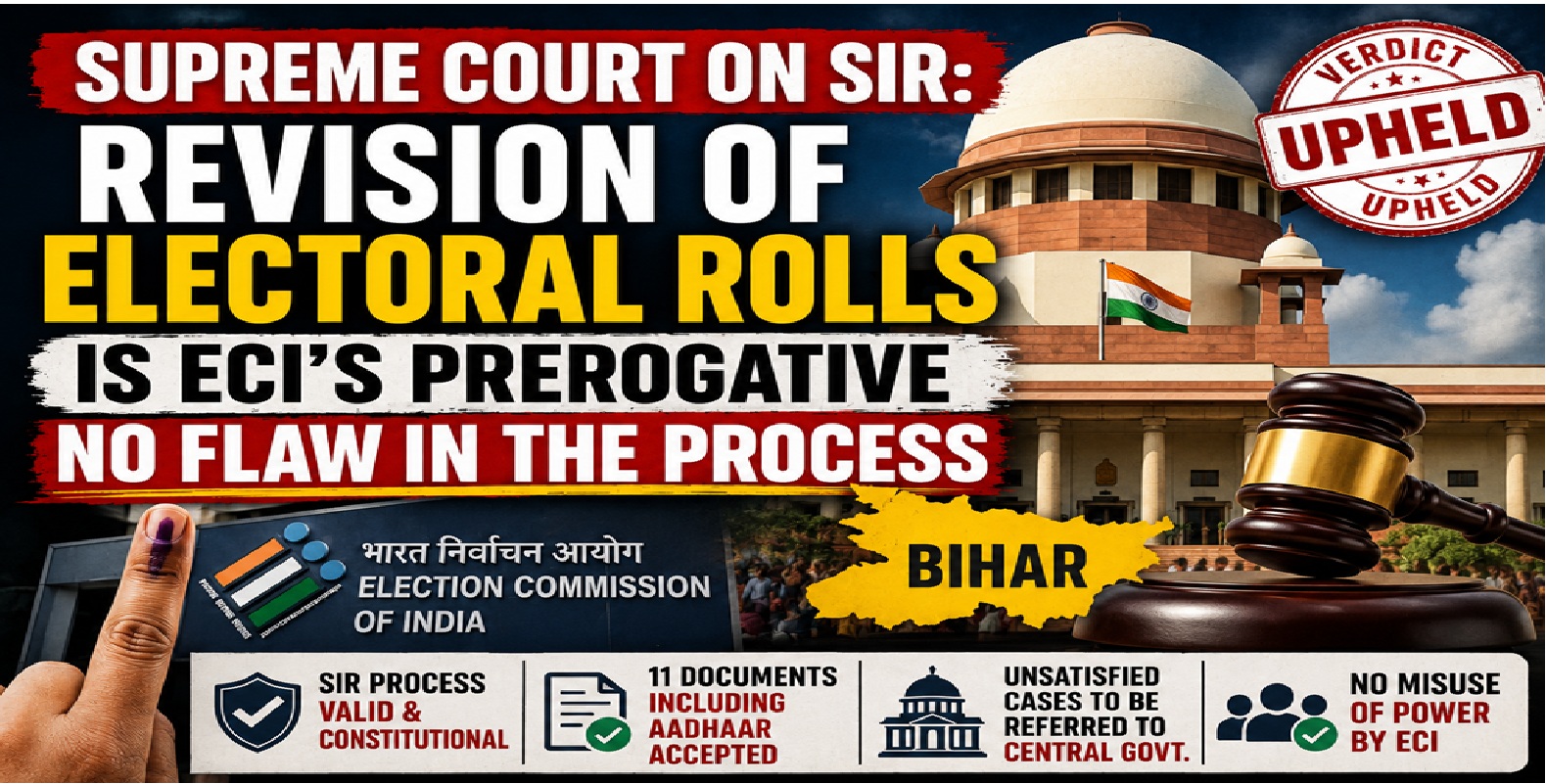
Supreme Court Upholds Bihar Electoral Roll Revision; Says ECI Has Full Constitutional Authority
Supreme Court Upholds Bihar Electoral Roll Revision; Says ECI Has Full Constitutional Authority
Supreme Court Upholds Bihar Electoral Roll Revision – The Supreme Court has upheld the Election Commission of India’s Special Intensive Revision (SIR) of Bihar’s electoral rolls, ruling the process constitutional and legally valid. Here’s what the verdict means for democracy, voter verification, and future elections in India.
Supreme Court Upholds Bihar Electoral Roll Revision – Supreme Court Backs ECI’s Special Intensive Revision in Bihar
Amit Kaul – For Digital Desk, Bengaluru: May 27, 2026 – In a landmark ruling with significant implications for India’s electoral system, the Supreme Court has upheld the Election Commission of India’s (ECI) decision to conduct a Special Intensive Revision (SIR) of electoral rolls in Bihar.
The judgment reinforces the constitutional autonomy of the Election Commission while clarifying that deviations from standard electoral revision procedures do not automatically make such exercises illegal or unconstitutional.
The ruling came from a bench headed by Chief Justice Surya Kant, which held that the SIR process falls squarely within the powers vested in the Election Commission under the Constitution and election laws.
The verdict is likely to have far-reaching political and administrative consequences, especially as debates over voter identity verification, electoral transparency, and institutional independence intensify across India.
https://digitalamitkaul.online/west-bengal-politics-history-2026-election-analysis/
Supreme Court Rejects Challenge to SIR Process
The petitions challenging the SIR exercise had argued that the Election Commission lacked the authority to undertake such a large-scale revision outside the ordinary framework used for electoral roll updates.
However, the Court firmly rejected that contention.
The bench observed that merely because the Special Intensive Revision differs from the routine process of electoral roll revision does not make it ultra vires or beyond the legal powers of the Commission.
The Court ruled that the process is legally sustainable and constitutionally permissible.
This is a major endorsement of the Election Commission’s discretionary authority in managing electoral processes under evolving circumstances.
What the Chief Justice Said
Chief Justice Surya Kant emphasized that the Election Commission’s actions were grounded in law and supported by procedural safeguards.
The Court specifically referred to the documentation framework adopted during the revision process. According to the bench, after reviewing the list of 11 accepted documents — including the Aadhaar card, which was incorporated following earlier judicial directions — there was no basis to conclude that the requirements imposed by the Commission were arbitrary.
Supreme Court Upholds Bihar Electoral Roll Revision – The Court further clarified an important procedural safeguard.
It stated that whenever the Election Commission is not satisfied about an individual’s eligibility for inclusion in the electoral rolls under statutory requirements, the matter should be referred to the competent authority of the Central Government for determination in accordance with the law.
This observation seeks to balance two competing concerns:
- Protecting the integrity of electoral rolls
- Preventing arbitrary exclusion of eligible voters
- Why This Verdict Matters
The judgment goes beyond Bihar. It potentially establishes a broader legal precedent regarding the Election Commission’s powers to conduct extraordinary electoral verification exercises.
A crucial constitutional matter was at the center of the dispute:
How much operational flexibility does the Election Commission possess while safeguarding electoral integrity?
The Supreme Court’s answer appears clear: substantial flexibility, provided actions remain within the framework of law and procedural fairness.
The verdict effectively strengthens the constitutional standing of the Election Commission of India, reaffirming its authority to undertake corrective or intensive verification measures when deemed necessary.
Debate Over Electoral Integrity vs Voter Exclusion
The SIR process had generated intense political debate.
Supporters argued that comprehensive verification of electoral rolls is essential to remove duplicate, fake, deceased, or otherwise invalid entries. They asserted that keeping correct voter rolls is essential to preserving democratic legitimacy.
Critics, however, raised concerns about possible voter exclusion, particularly among economically weaker sections, migrant populations, and individuals lacking easy access to documentation.
Civil society groups and opposition petitioners had questioned whether such a large-scale revision exercise could inadvertently disenfranchise legitimate voters.
The Supreme Court’s ruling attempts to address these concerns by emphasizing procedural safeguards and legal accountability mechanisms rather than invalidating the process itself.
Supreme Court Upholds Bihar Electoral Roll Revision – Court Finds No Abuse of Power
One of the most significant aspects of the ruling is the Court’s explicit statement that the Election Commission did not misuse its powers.
The bench observed that the Commission acted strictly in accordance with the law and within the constitutional framework governing electoral administration.
This judicial endorsement is politically important because recent years have witnessed increasing scrutiny of constitutional institutions, including the Election Commission.
At a time when election transparency is still a politically delicate topic, the Court has successfully strengthened the Commission’s institutional legitimacy by maintaining the SIR procedure.
Aadhaar and Electoral Verification
The inclusion of Aadhaar as an accepted document during the SIR process also carries important implications.
The function of Aadhaar in governance systems has been the subject of continuous discussions in India, particularly in relation to privacy, citizenship issues, and welfare access.
In the electoral context, Aadhaar-linked verification has been presented as a tool to improve voter database accuracy and reduce duplication.
However, critics continue to warn against overdependence on documentation systems that may disadvantage vulnerable populations.
The Supreme Court’s reference to Aadhaar in this case indicates judicial acceptance of its limited procedural role within broader electoral verification mechanisms.
Political and Electoral Implications
The ruling is expected to influence future electoral roll revision exercises across India, especially ahead of major state elections and national polls.
It may also encourage the Election Commission to adopt more aggressive verification measures in states where concerns over duplicate or disputed voter entries arise.
At the same time, the judgment places responsibility on the Commission to ensure transparency, fairness, and accessible grievance redressal systems during such exercises.
https://aamnewsnetwork.com/nashik-tcs-case-supreme-court-forced-conversion-sexual-harassment/
Political analysts believe the verdict could shape future debates around:
- Electoral reforms
- Digital voter verification
- Citizenship documentation
- Migration-linked voter registration challenges
- Institutional independence of the ECI
- A Defining Moment for Electoral Governance
The Supreme Court’s decision ultimately reflects a broader constitutional principle: electoral integrity and democratic participation must coexist.
By refusing to strike down the SIR process while simultaneously emphasizing legal safeguards, the Court has attempted to maintain institutional balance.
For the Election Commission, the verdict is a major validation of its constitutional authority.
For political parties and voters, however, the larger debate over how to ensure both clean electoral rolls and universal democratic inclusion is far from over.
As India prepares for increasingly complex elections in the coming years, the Bihar SIR judgment may well become one of the defining legal precedents shaping the future of electoral governance in the country.
Author Bio
Amit Kaul is a professional content writer and digital news strategist based in Bengaluru (India). With over a decade of experience covering transportation, technology, and travel, Amit specializes in creating SEO-optimized, engaging news content for digital platforms. He focuses on in-depth reporting, trend analysis, and reader-friendly storytelling, ensuring articles reach a global audience effectively.