
Expensive Crude Oil May Slow India’s Growth to 6% in FY27, Inflation Likely to Rise: EY Analysis
Expensive Crude Oil May Slow India’s Growth to 6% in FY27, Inflation Likely to Rise: EY Analysis
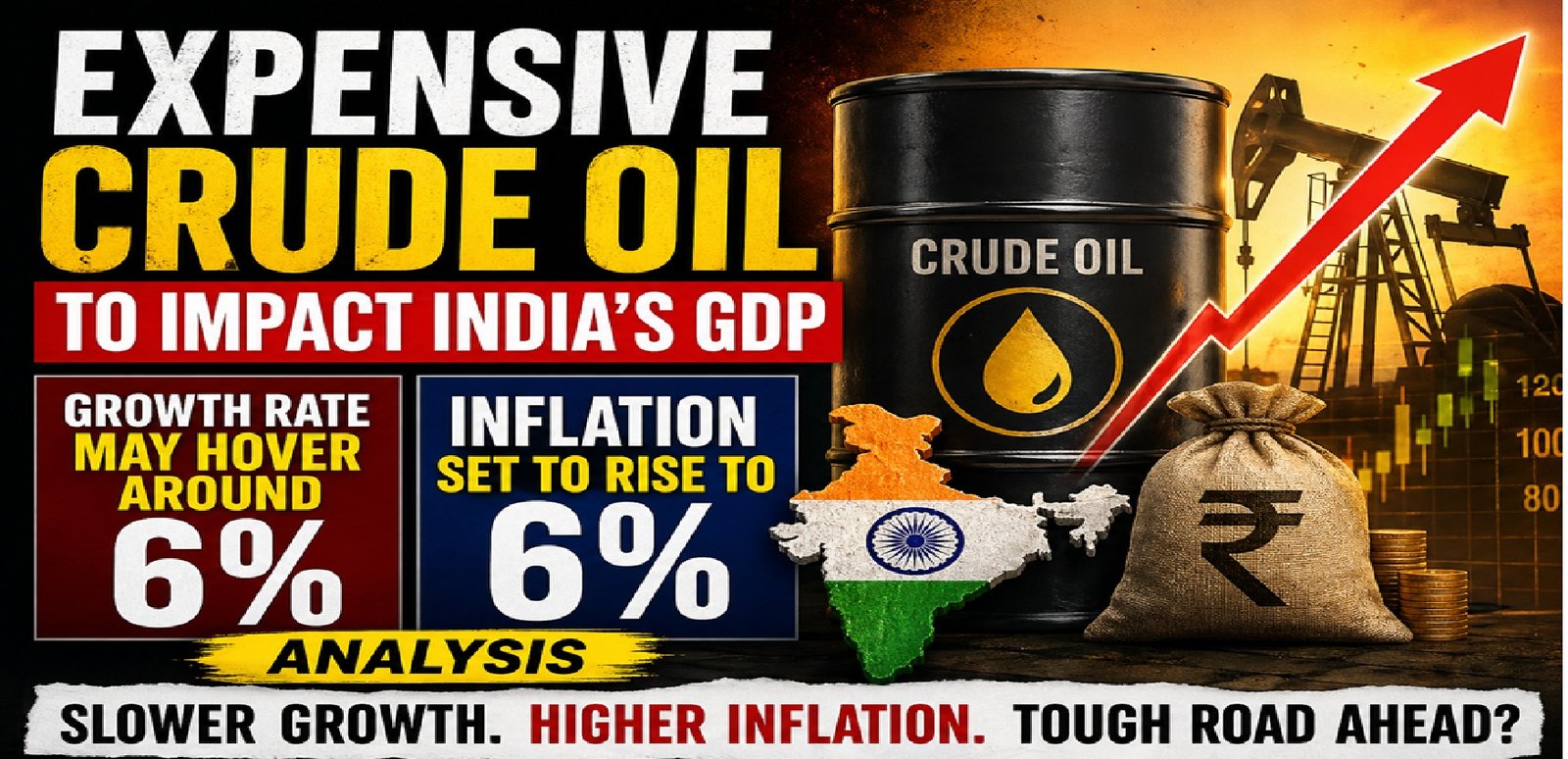
Expensive Crude Oil May Slow India’s Growth to 6% in FY27: Rising crude oil prices could drag India’s GDP growth to around 6% and push inflation higher in FY2026-27, warns EY India. What it entails for the economy is as follows.
Amit Kaul – For Digital Desk, Bengaluru: April 29, 2026 – India’s economic outlook for the upcoming fiscal year is facing renewed uncertainty as global crude oil prices continue to surge amid geopolitical tensions in West Asia. According to a recent assessment by EY India, persistently high oil prices could significantly impact the country’s growth trajectory and inflation dynamics in FY2026-27.
The report suggests that if crude oil prices remain elevated at around $120 per barrel throughout the fiscal year, India’s real GDP growth may slow to approximately 6%, while retail inflation could rise to nearly 6%. This projection underscores the vulnerability of India’s economy to external energy shocks, given its heavy reliance on imported crude oil.
Crude Oil: A Critical Economic Driver
Crude oil plays a central role in India’s economic structure, influencing everything from transportation and manufacturing to household consumption. India is especially vulnerable to changes in the world’s energy costs because it is one of the biggest importers of oil.
When oil prices rise, the cost of production and logistics increases across sectors. This leads to higher prices for goods and services, directly contributing to inflation. At the same time, elevated import bills strain the country’s fiscal balance and current account deficit, creating additional macroeconomic pressure.
D.K. Srivastava, Chief Policy Advisor at EY India, highlighted that sustained high crude prices would leave policymakers with limited room to maneuver. “If the average price of India’s crude basket remains at $120 per barrel, growth could moderate while inflation inches upward,” he noted.
Expensive Crude Oil May Slow India’s Growth to 6% in FY27: Inflationary Pressures on the Rise
One of the most immediate consequences of expensive crude oil is rising inflation, particularly measured through the Consumer Price Index (CPI). Higher fuel costs translate into increased transportation expenses, which in turn raise the prices of essential commodities such as food and consumer goods.
The report indicates that inflation could approach the 6% mark—close to the upper tolerance limit set by the Reserve Bank of India (RBI). This scenario poses a challenge for monetary policy, as the central bank may need to prioritize inflation control over growth stimulation.
Moreover, higher inflation erodes household purchasing power, potentially dampening consumer demand—a key driver of India’s GDP.
Fiscal Deficit Concerns
Another major concern highlighted in the analysis is the pressure on India’s fiscal deficit. The government often absorbs part of the impact of rising oil prices by reducing excise duties or offering subsidies. However, this approach has limits, especially when prices remain elevated for extended periods.
Srivastava emphasized that to contain the fiscal deficit, a larger portion of the burden may need to be passed on to consumers. This could mean higher fuel prices at the pump, which would further contribute to inflationary pressures.
Balancing fiscal discipline with economic stability will be a critical challenge for policymakers in the coming months.
Policy Options: Limited but Crucial
The EY report outlines several potential policy responses, though it acknowledges that the scope for intervention is constrained. One option could be a hike in the repo rate by the RBI to control inflation. However, higher interest rates may also slow down investment and economic activity.
Another key recommendation is the rapid diversification of crude oil import sources. By reducing dependence on specific regions, particularly geopolitically volatile ones, India can mitigate supply risks and stabilize prices over the long term.
https://digitalamitkaul.online/strait-of-hormuz-crisis-global-energy-supply/
Additionally, accelerating the transition to renewable energy and enhancing domestic energy production could provide structural relief, although these measures will take time to yield significant results.
Expensive Crude Oil May Slow India’s Growth to 6% in FY27: Global Supply Recovery May Take Time
The ongoing tensions in West Asia remain a major source of uncertainty for global oil markets. According to the analysis, even if the geopolitical situation stabilizes, the normalization of oil supply may not happen immediately.
Supply chains disrupted by conflict or sanctions often take months—or even years—to fully recover. This means that high oil prices could persist longer than anticipated, prolonging their impact on economies like India.
Srivastava cautioned that policymakers should prepare for a prolonged period of elevated energy costs and plan accordingly.
What It Means for India
If the projections hold, India could face a dual challenge of slower growth and higher inflation—a scenario often referred to as “stagflation-lite.” While a 6% growth rate remains robust compared to many global economies, it represents a slowdown from India’s higher growth aspirations.
For businesses, this environment could mean higher input costs and tighter margins. For consumers, it could translate into increased living expenses and reduced disposable income.
However, India’s strong domestic demand, ongoing infrastructure investments, and policy reforms could help cushion the impact to some extent.
https://aamnewsnetwork.com/tesla-model-y-long-wheelbase-india-price-features/
Expensive Crude Oil May Slow India’s Growth to 6% in FY27: Conclusion
The EY India analysis serves as a timely reminder of the interconnected nature of global and domestic economic factors. As crude oil prices remain elevated, India’s economic resilience will be tested on multiple fronts—from inflation management to fiscal discipline and energy security.
While immediate policy options may be limited, strategic measures such as diversifying energy sources and strengthening domestic capabilities could play a crucial role in navigating this challenging phase.
Author Bio
Amit Kaul is a professional content writer and digital news strategist based in Bengaluru (India). With over a decade of experience covering transportation, technology, and travel, Amit specializes in creating SEO-optimized, engaging news content for digital platforms. He focuses on in-depth reporting, trend analysis, and reader-friendly storytelling, ensuring articles reach a global audience effectively.



Pingback: Petrol Was Once Cheaper Than Water in India: How Fuel Prices Skyrocketed From Paise to ₹100+ Per Liter - DNN
Pingback: Indian Economy Defies Global Headwinds: GDP Growth Climbs to 7.8% in Q4, Reinforcing India's Position as the World's Fastest-Growing Major Economy - ANN