
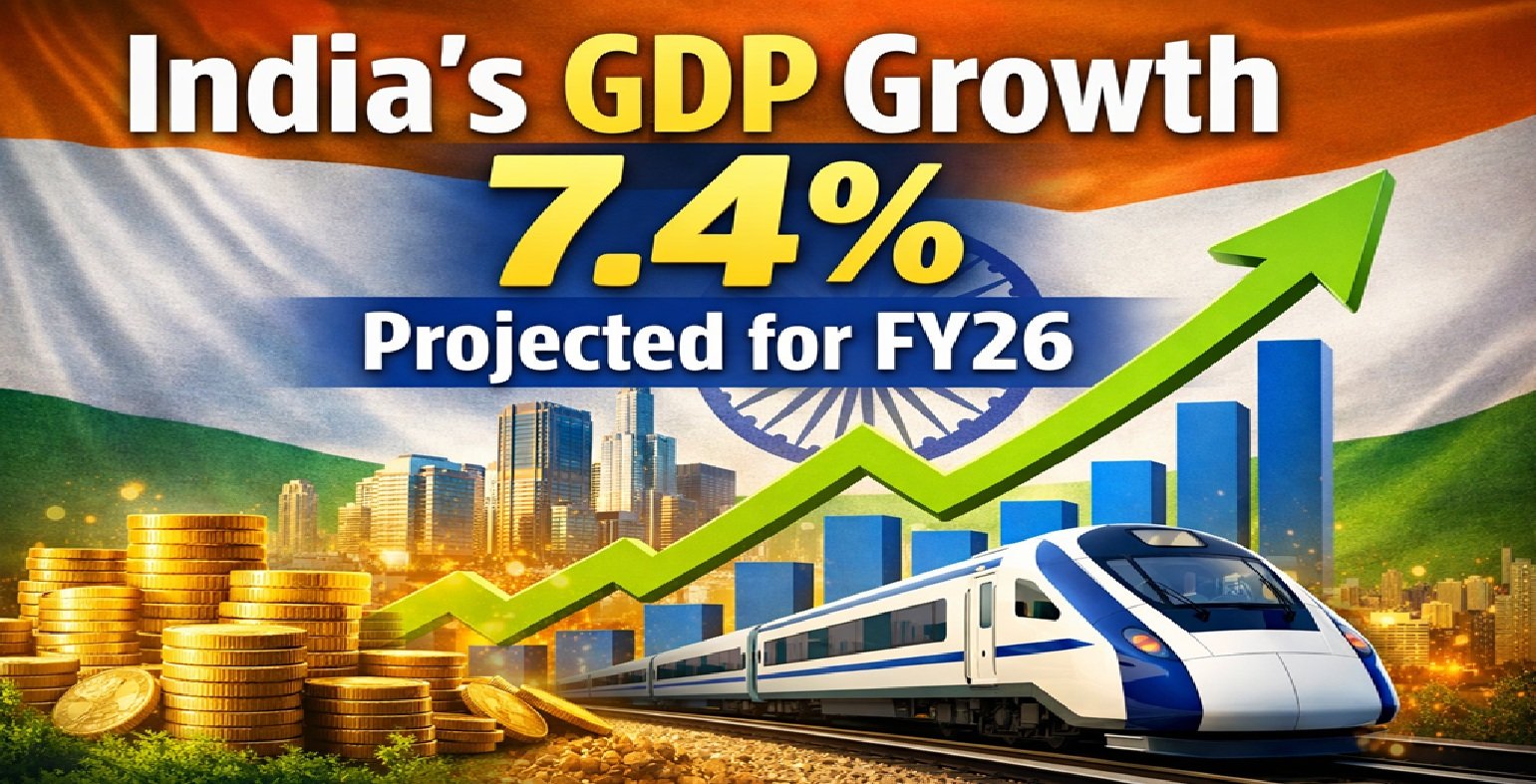
India’s GDP Growth Projected at 7.4% for FY26, Signals Strong Economic Momentum
India’s GDP Growth Projected at 7.4% for FY26, Signals Strong Economic Momentum
India’s GDP growth is projected at 7.4% for FY26, driven by strong domestic demand, manufacturing expansion, and record infrastructure investment. Read full analysis.
India’s Economy Set to Remain Among the World’s Fastest-Growing
Amit Kaul – For Business Desk, Bengaluru: January 8, 2026 – India’s economy is projected to grow at 7.4% in the financial year 2025–26 (FY26), according to advance estimates released by official sources. The robust forecast reinforces India’s position as the fastest-growing major economy in the world, at a time when several global economies continue to struggle with inflationary pressures, geopolitical uncertainty, and slowing demand.
The growth projection reflects strong domestic consumption, sustained manufacturing expansion, and a continued push in infrastructure spending, all of which have emerged as key pillars supporting India’s macroeconomic resilience.
India’s GDP Growth Projected at 7.4% for FY26: Domestic Consumption Remains the Growth Engine
One of the most significant drivers of India’s projected GDP growth is healthy domestic demand. Rising incomes, stable employment trends, and increased urban and rural consumption have played a crucial role in supporting economic expansion.
https://digitalamitkaul.online/india-upi-record-december-2025/
Consumer spending has remained resilient despite global headwinds, supported by:
- Strong festive season demand
- Growth in retail credit
- Expansion of e-commerce and digital payments
- Improved rural sentiment due to stable agricultural output
Economists note that India’s consumption-led growth model provides a buffer against global volatility, especially at a time when export demand from advanced economies has softened.
Manufacturing Sector Gains Momentum
India’s manufacturing sector continues to show steady improvement, supported by policy initiatives such as Production Linked Incentive (PLI) schemes, supply chain diversification, and increased private sector participation.
Key manufacturing segments showing growth include:
- Electronics and semiconductors
- Automobiles and electric vehicles
- Pharmaceuticals and medical devices
- Capital goods and heavy engineering
The government’s focus on “Make in India” and reducing import dependence has resulted in higher capacity utilization and fresh investment commitments from both domestic and foreign companies.
Manufacturing growth has also contributed to job creation, strengthening the consumption cycle further.
India’s GDP Growth Projected at 7.4% for FY26: Infrastructure Spending Fuels Long-Term Growth
A major contributor to the FY26 growth outlook is the government’s sustained capital expenditure (capex) push, particularly in infrastructure development.
Large investments are being made in:
- Highways and expressways
- Railways and metro networks
- Ports, logistics, and airports
- Renewable energy and power transmission
Public sector capex has acted as a catalyst for private investment, improving logistics efficiency and lowering transaction costs across the economy. Analysts believe infrastructure-led growth will have a long-term multiplier effect, boosting productivity and regional development.
India’s GDP Growth Projected at 7.4% for FY26: Services Sector Continues to Anchor Stability
India’s services sector, which accounts for more than half of GDP, remains a key stabilizer. IT services, financial services, tourism, hospitality, and professional services have continued to expand steadily.
While global technology spending has moderated, India’s IT sector has benefited from:
- Digital transformation projects
- Cloud adoption
- AI and data services demand
Financial services have also performed well, supported by improved balance sheets of banks, lower non-performing assets, and steady credit growth.
Inflation and Fiscal Discipline Remain Watch Areas
Despite the positive outlook, policymakers remain cautious about potential risks. Inflation management, particularly food inflation, continues to be a priority for the government and the Reserve Bank of India (RBI).
The RBI’s calibrated monetary policy approach has helped maintain macroeconomic stability, while the government’s focus on fiscal consolidation has reassured investors and rating agencies.
Maintaining a balance between growth-supportive spending and fiscal prudence will be crucial in sustaining long-term economic momentum.
Global Uncertainty, Domestic Strength
Globally, economic growth remains uneven, with advanced economies facing slower expansion and emerging markets navigating capital flow volatility. However, India’s domestic-demand-driven growth model, large market size, and demographic advantage provide insulation against external shocks.
International institutions and investors continue to view India as a key growth destination, supported by:
- Political stability
- Structural reforms
- Digital public infrastructure
- Expanding middle class
Outlook: India on a Sustainable Growth Path
The 7.4% GDP growth projection for FY26 highlights India’s strong economic fundamentals and the effectiveness of policy-driven growth strategies. While global challenges persist, India’s focus on consumption, manufacturing, and infrastructure investment positions it well for sustained expansion.
https://aamnewsnetwork.com/india-private-sector-growth-slows-manufacturing-pmi-november-2025/
Economists believe that if reforms continue and investment momentum remains intact, India could maintain growth rates above 7% in the medium term, reinforcing its role as a central pillar of the global economy.
Author Bio
Amit Kaul is a professional content writer and digital news strategist based in India. With over a decade of experience covering Finance, business, transportation, technology, and travel, Amit specializes in creating SEO-optimized, engaging news content for digital platforms. He focuses on in-depth reporting, trend analysis, and reader-friendly storytelling, ensuring articles reach a global audience effectively.



Pingback: Indian Stock Markets Rebound After Five-Day Fall as Banking, IT Stocks Surge - DNN
Pingback: India Relaxes Defence FDI Norms to Boost Manufacturing - DNN
Pingback: India’s Smartphone Exports Touch Record $30 Billion, Driven by PLI Push and Global Manufacturing Shift - ANN
Pingback: India Celebrates 77th Republic Day with Patriotic Grandeur at Kartavya Path - DNN
Pingback: India–U.S. Relations Take Center Stage as Trump Hails “Historic Bond” on 77th Republic Day - DNN