
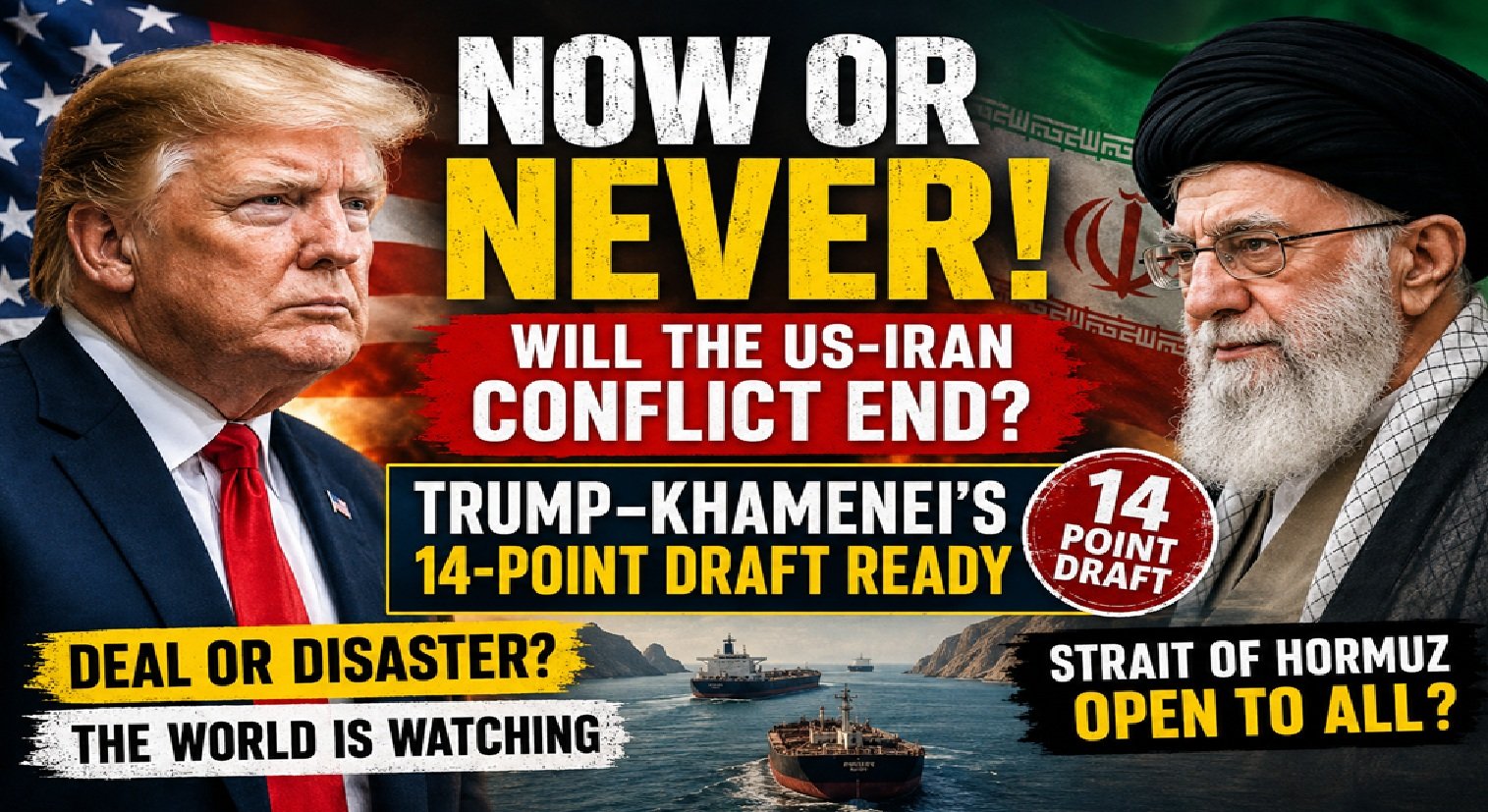
Now or Never: Will the US-Iran Conflict End? Trump–Khamenei 14-Point Draft Signals Historic Turning Point
Now or Never: Will the US-Iran Conflict End? Trump–Khamenei 14-Point Draft Signals Historic Turning Point
Now or Never: A potential US-Iran breakthrough emerges as Trump and Khamenei review a 14-point draft agreement. Will this deal end decades of hostility or trigger a new escalation in the Strait of Hormuz?
Introduction: A Critical Moment in Global Geopolitics
Amit Kaul – For Digital Desk, Bengaluru: May 6, 2026 – The long-standing tensions between the United States and Iran may be approaching a decisive inflection point. According to recent reports, including insights from Axios, both sides are reportedly closing in on a one-page Memorandum of Understanding (MoU) built around a 14-point framework. If finalized, this agreement could redefine power dynamics in the Middle East and beyond.
At the center of this high-stakes diplomacy are two polarizing figures—Donald Trump and Ali Khamenei—whose decisions in the coming days could determine whether the region moves toward stability or spirals into conflict.
https://aamnewsnetwork.com/khalistani-extremism-canada-csis-report-security-threat-analysis/
Now or Never: The 14-Point Draft: What’s on the Table?
While the full details of the draft remain undisclosed, sources suggest that the framework focuses on three core pillars:
- Nuclear Program Restrictions
Iran is expected to agree to stricter limitations on uranium enrichment, potentially exceeding previous commitments under the Joint Comprehensive Plan of Action. In return, international monitoring mechanisms may be recalibrated to balance transparency with sovereignty concerns.
- Sanctions Relief
The United States may offer phased relief from crippling economic sanctions that have severely impacted Iran’s economy. However, this relief is likely to be conditional, tied to verifiable compliance with nuclear restrictions.
- Strait of Hormuz Security
A breakthrough could come in the form of guaranteed freedom of navigation through the Strait of Hormuz, a critical artery for global oil supply. This would significantly reduce risks for international shipping and stabilize energy markets.
Operation Epic Fury: Diplomacy Backed by Threat
In a move characteristic of his negotiation style, Donald Trump has announced that “Operation Epic Fury” will be halted if Iran accepts the proposed terms. However, his warning was stark: rejection would lead to military action “on a scale and intensity far greater than ever before.”
This dual-track approach—offering diplomacy while signaling overwhelming force—echoes Trump’s earlier foreign policy tactics. It places immense pressure on Iran’s leadership, particularly Khamenei, to weigh the costs of defiance against the potential benefits of agreement.
Now or Never: Iran’s Strategic Calculus
For Iran, the stakes are equally high. Years of economic sanctions have led to inflation, currency depreciation, and domestic unrest. Accepting the deal could provide immediate economic relief and reintegration into global markets.
However, there are internal challenges. Hardline factions within Iran may view concessions as a compromise of national sovereignty. Khamenei must balance these domestic pressures with the broader strategic need to avoid military confrontation.
Now or Never – Global Implications: Beyond Washington and Tehran
The outcome of this potential deal will reverberate far beyond bilateral relations.
Energy Markets
A secure Strait of Hormuz could stabilize global oil prices, benefiting both importing and exporting nations. Any disruption, on the other hand, could trigger price spikes and economic uncertainty.
Middle East Stability
Regional actors such as Saudi Arabia and Israel are closely monitoring developments. A deal could ease tensions, but skepticism remains, particularly regarding Iran’s long-term intentions.
Global Power Dynamics
Major powers like China and Russia also have strategic interests in the outcome. A US-Iran rapprochement could shift alliances and influence geopolitical alignments.
Challenges Ahead: Why a Deal Is Not Guaranteed
Despite optimistic signals, several obstacles remain:
- Verification Mechanisms: Ensuring compliance without infringing on sovereignty is a persistent challenge.
- Political Will: Both leaders face domestic constituencies that may resist compromise.
- Trust Deficit: Decades of hostility cannot be erased overnight; skepticism runs deep on both sides.
Moreover, the shadow of past failures—particularly the US withdrawal from the JCPOA—continues to influence current negotiations.
https://digitalamitkaul.online/power-bank-explosion-indigo-flight-mohali-airport-incident/
Conclusion: A Defining Test of Leadership
The proposed 14-point MoU represents more than just a diplomatic agreement—it is a test of leadership for both Donald Trump and Ali Khamenei. The choices they make will not only shape the future of US-Iran relations but also determine the trajectory of Middle Eastern geopolitics.
Is this truly a “now or never” moment? The answer lies in whether both sides can move beyond rhetoric and seize the opportunity for lasting peace. If they succeed, it could mark the beginning of a new chapter. If they fail, the consequences could be far-reaching—and potentially devastating.
Author Bio
Amit Kaul is a professional content writer and digital news strategist based in Bengaluru (India). With over a decade of experience covering transportation, technology, and travel, Amit specializes in creating SEO-optimized, engaging news content for digital platforms. He focuses on in-depth reporting, trend analysis, and reader-friendly storytelling, ensuring articles reach a global audience effectively.



Pingback: US to Close Peshawar Consulate: Is Trump Signaling a Bigger Strategic Shift in Pakistan? - DNN
Pingback: Iranian Attacks on US Bases Caused Far More Destruction Than Reported: Satellite Imagery Raises Serious Questions - ANN
Pingback: Suicide Bombing Rocks Pakistan’s Khyber Pakhtunkhwa; 15 Security Personnel Killed in Bannu Attack - DNN