
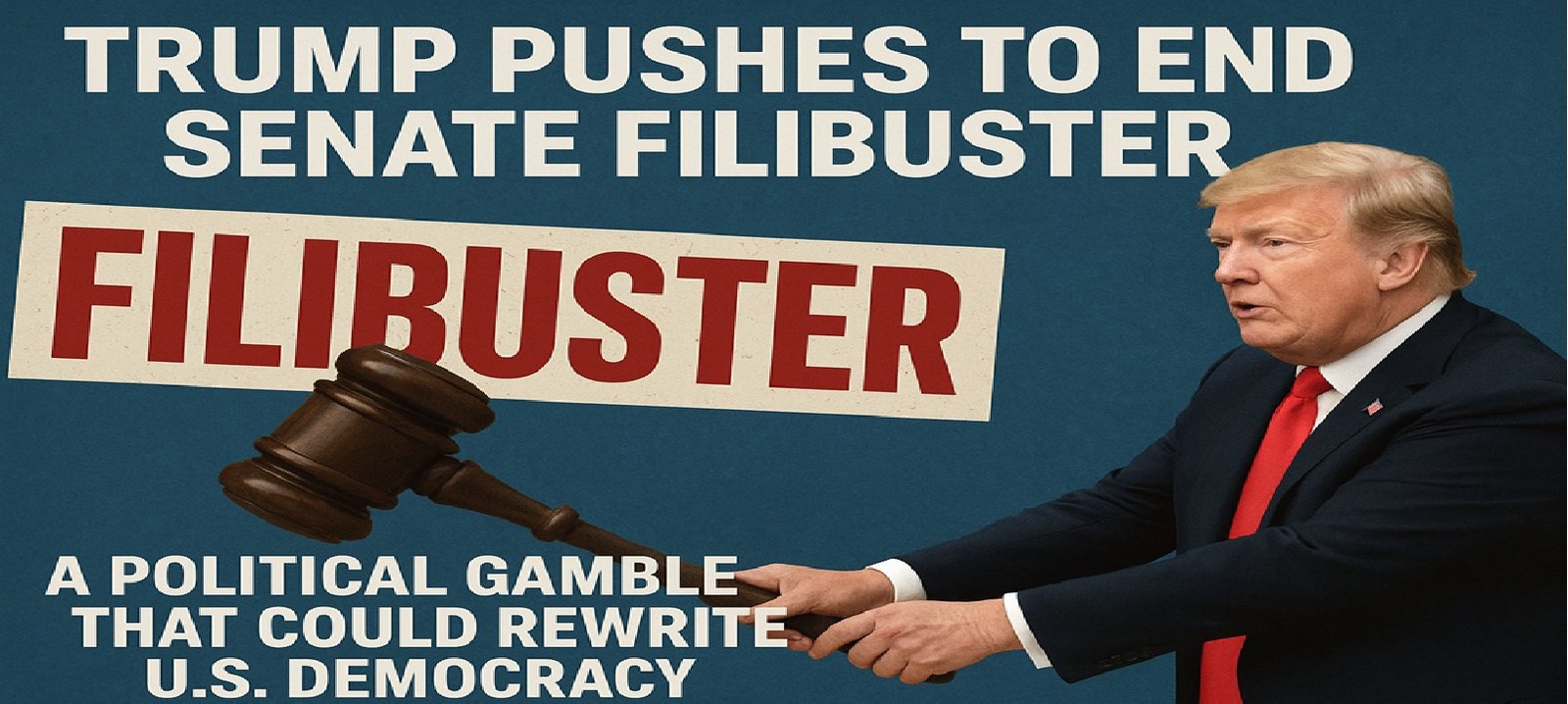
Trump Pushes to End Senate Filibuster: A Political Gamble That Could Rewrite U.S. Democracy
Trump Pushes to End Senate Filibuster: A Political Gamble That Could Rewrite U.S. Democracy
Trump Pushes to End Senate Filibuster: Donald Trump is urging Republicans to abolish the Senate filibuster, a move that could radically reshape how U.S. laws are passed. Here’s what the filibuster fight means for democracy and political power in Washington.
Former U.S. President Donald Trump has reignited one of Washington’s most contentious debates — the future of the Senate filibuster. In a recent address, Trump called on Republicans to “end the filibuster once and for all,” framing the move as essential to breaking political deadlock and advancing conservative priorities.
https://digitalamitkaul.online/us-china-trade-deal-progress-global-markets-rally-asia-stocks/
But critics argue that this step could fundamentally alter American democracy, weakening minority voices and setting the stage for political chaos when power inevitably changes hands.
⚙️ What Is the Filibuster and Why Does It Matter: Trump Pushes to End Senate Filibuster
The Senate filibuster is a long-standing rule requiring 60 votes to advance most legislation. Originally designed to promote consensus, it now acts as a powerful obstruction tool, allowing the minority party to block bills even when the majority supports them.
In recent years, both Democrats and Republicans have used the filibuster to stall each other’s agendas — from immigration reform and gun control to tax and budget measures. Trump’s proposal would remove that barrier, letting the Senate pass laws with a simple majority of 51 votes.
💣 Trump’s Political Strategy
Trump’s renewed call comes amid growing frustration among his allies over the ongoing government shutdown and Democratic resistance to several policy measures. He argues that eliminating the filibuster would “let the people’s will be done” and prevent what he calls “endless obstruction by career politicians.”
Republican insiders suggest this strategy aims to fast-track conservative reforms, particularly in immigration, energy policy, and judicial appointments — but it could also backfire if the GOP loses control of the Senate in future elections.
⚖️ The Republican Divide: Trump Pushes to End Senate Filibuster
Even within Trump’s own party, the idea has sparked division. Senior GOP senators — including Mitch McConnell and Susan Collins — have publicly opposed scrapping the rule, warning that the filibuster protects institutional balance.
McConnell, once a staunch Trump ally, said:
“The Senate was designed to cool political passions. Ending the filibuster turns it into a second House of Representatives — ruled by the majority of the moment.”
Their concern is not unfounded. Without the filibuster, future majorities could easily reverse laws passed by their predecessors, creating policy instability and legislative whiplash.
🗳️ Democratic Response
Democrats, meanwhile, have seized on Trump’s remarks as proof of his authoritarian tendencies. Senate Majority Leader Chuck Schumer called the proposal “a direct assault on the checks and balances that define the Republic.”
However, some progressive voices within the Democratic Party have themselves flirted with ending the filibuster in the past, particularly when Republicans used it to block voting rights and gun-reform legislation.
This reflects a paradox in modern U.S. politics — both sides criticize obstructionism, but neither wants to surrender the tool when in opposition.
🌍 Global Context & Historical Echoes
Globally, political analysts say the U.S. debate mirrors broader questions about majority rule vs. minority rights in democracies worldwide. From India’s parliamentary walkouts to Britain’s Brexit gridlock, the struggle between efficiency and representation is universal.
Historians note that the last major rule change — the 2013 and 2017 partial eliminations of the filibuster for judicial appointments — already transformed the federal courts. Trump’s full repeal proposal could extend that precedent to all legislation, cementing his political legacy whether or not it succeeds.
https://aamnewsnetwork.com/trump-japan-visit-takaichi-meeting-trade-security-talks/
🧭 Conclusion: A High-Stakes Gamble
For now, the Senate remains divided, and the filibuster stands. But Trump’s renewed pressure has reignited a debate that cuts to the core of American governance — should the majority always rule, or must the minority always have a voice?
As the 2025 political season heats up, the filibuster fight is more than a procedural battle. It’s a test of how far U.S. democracy can bend before it breaks — and whether the rules of the game should change to match the times.



Pingback: Trump Rejects Missile Aid to Ukraine: “No Tomahawks — This Isn’t Our Fight” - ANN