
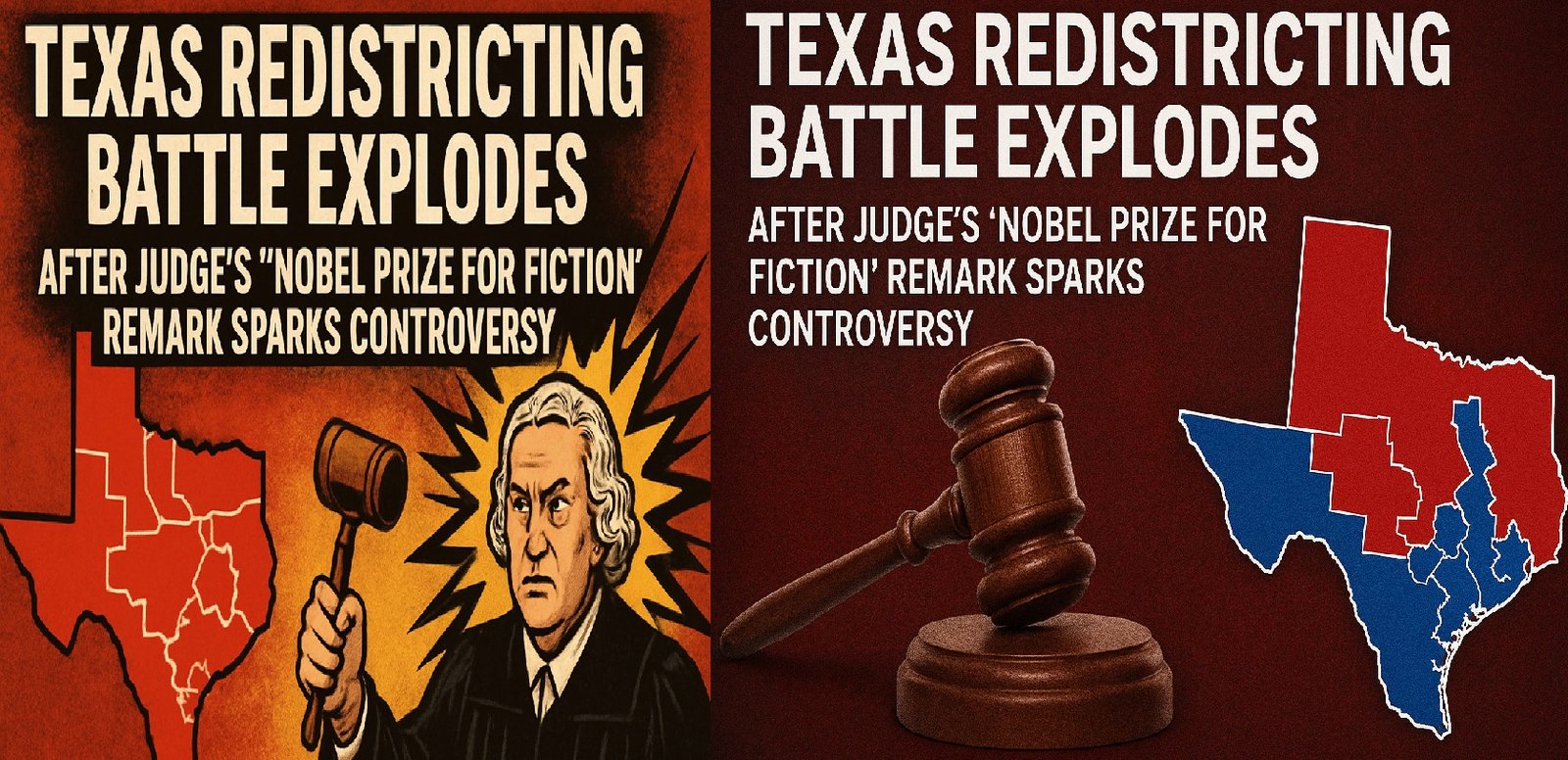
Texas Redistricting Battle Explodes After Judge’s “Nobel Prize for Fiction” Remark Sparks Controversy
Texas Redistricting Battle Explodes After Judge’s “Nobel Prize for Fiction” Remark Sparks Controversy
Texas Redistricting Battle Explodes: A Texas judge sparks national controversy after calling a colleague’s redistricting opinion a “Nobel prize for fiction”. Full breakdown of the legal and political fallout.
📰 Texas Redistricting Case Erupts After Judge Calls Colleague’s Opinion a “Nobel Prize for Fiction”
A major legal and political storm has engulfed Texas after a US federal judge issued a blistering 104-page dissent in a high-profile redistricting case, calling a colleague’s opinion worthy of a “Nobel prize for fiction.” The unusually harsh language — and repeated references to billionaire George Soros — have thrust the court’s internal divisions into the national spotlight and reignited debate over voting rights, gerrymandering, and judicial conduct in the United States.
The controversy centers around a federal court ruling that challenged the legality of Texas’s newly drawn congressional districts. Civil rights groups had argued that the maps diluted the voting power of minority communities, particularly Hispanic and Black populations. While the majority opinion sided with these arguments and found significant Voting Rights Act violations, Judge Jerry E. Smith issued a scathing dissent that shocked legal experts and political analysts alike.
https://aamnewsnetwork.com/faa-air-traffic-reduction-2025-us-government-shutdown/
Judge dissent controversy
In his dissent, Judge Smith accused the majority of crafting a narrative “unsupported by law, evidence, or reality.” His comparison of the opinion to a fictional masterpiece — a “Nobel prize for fiction” — triggered widespread reaction across the political spectrum. Many viewed the language as unprofessional and inflammatory, while others praised the judge for what they described as “refreshing honesty” about politically motivated map challenges.
Smith’s dissent didn’t end with literary insults. In a move that further fueled controversy, he referenced George Soros multiple times, suggesting that groups backed by the billionaire philanthropist were influencing the legal proceedings. Critics immediately accused Smith of injecting conspiracy-laden rhetoric into a formal court opinion, undermining judicial neutrality.
Legal scholars expressed alarm at the increasingly politicized language appearing in federal rulings. According to experts, such public clashes within the judiciary threaten to erode confidence in the courts at a time when election laws remain one of the nation’s most contested issues. Many noted that disagreements between judges are normal, but the escalating tone and accusations seen in this case mark a significant departure from traditional judicial decorum.
The State of Texas stands at the center of this renewed legal battle. The state’s population surged in recent years, primarily driven by growth in minority communities. Critics argue that the newly drawn districts fail to reflect those demographic realities and instead favor one political party. Supporters of the maps maintain they are fair, constitutional, and based solely on population data — not political advantage.
The sharp divide between the majority ruling and Smith’s dissent underscores broader national tensions over redistricting. Across the country, both parties have faced lawsuits accusing them of manipulating district boundaries for partisan gain. As the 2026 midterm elections approach, the outcome of the Texas case could have significant implications not only for the state but for future legal challenges nationwide.
Judicial conflict
Civil rights groups welcomed the majority ruling, calling it a step toward restoring fair representation for Texas voters. They argue that the state repeatedly draws maps that weaken the electoral influence of minority communities. Texas officials, however, have vowed to appeal, setting the stage for a lengthy legal battle that may ultimately reach the US Supreme Court.
Meanwhile, Judge Smith’s dramatic dissent continues to dominate headlines, sparking debate over whether judges should be held to higher standards of language and conduct. Many worry that such aggressive, politically charged rhetoric risks normalizing hostility in judicial opinions and further polarizing an already divided nation.
https://digitalamitkaul.online/fbi-foils-isis-inspired-halloween-terror-attack-detroit/
As appeals move forward, the Texas redistricting case remains a pivotal legal and political flashpoint. The ruling — and the explosive dissent — will shape discussions on voting rights, judicial ethics, and democratic representation for months to come.


Pingback: India & Canada Near $2.8 Billion Uranium Supply Deal: A New Chapter in Strategic Energy Ties - DNN