
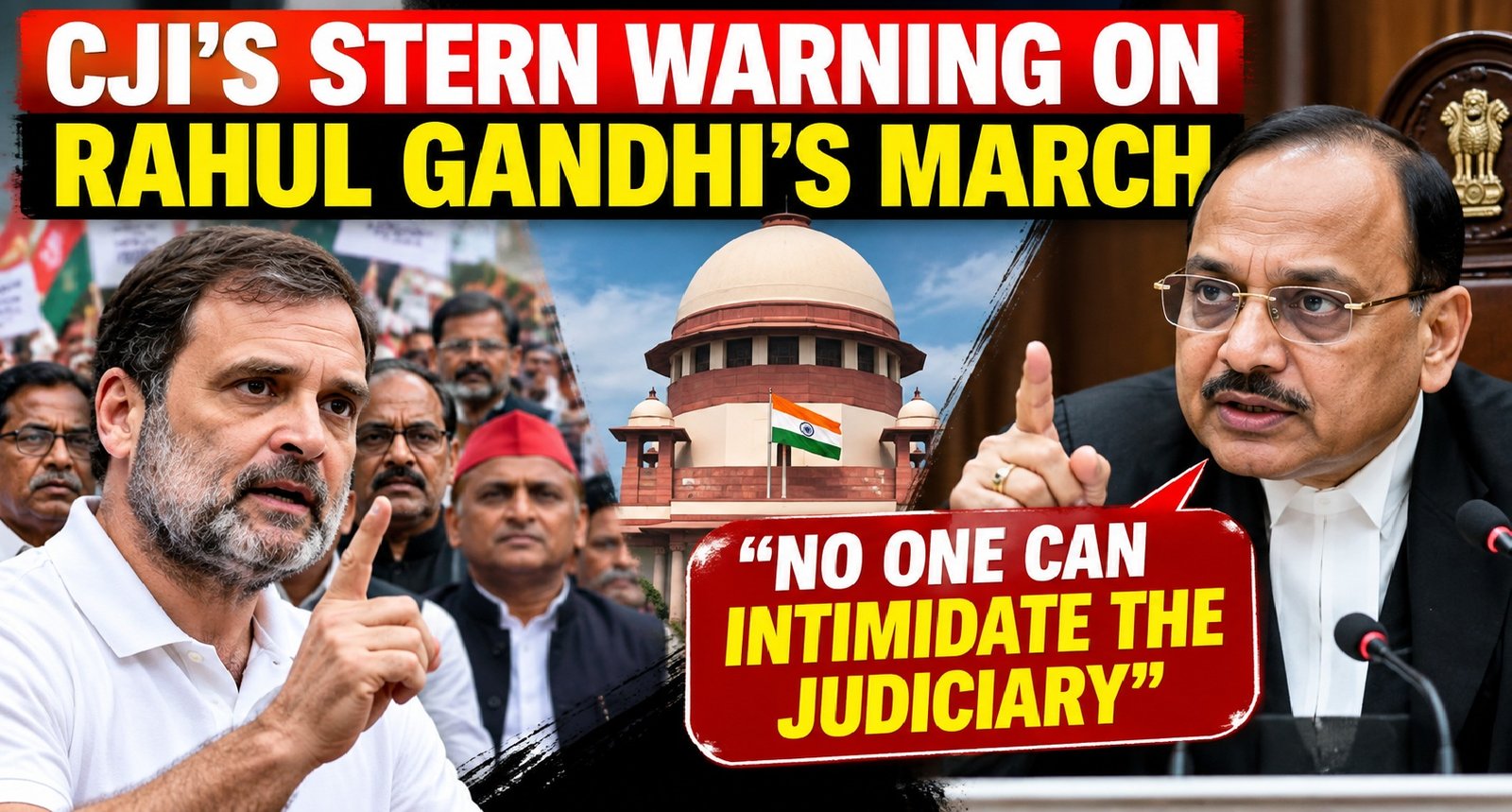
Rahul Gandhi’s Supreme Court March Sparks CJI’s Stern Warning: What Happened in Court?
Rahul Gandhi’s Supreme Court March Sparks CJI’s Stern Warning: What Happened in Court?
Rahul Gandhi’s Supreme Court March: CJI Surya Kant says no one can intimidate the judiciary as the Supreme Court issues notices to Rahul Gandhi and the Election Commission over SIR voter deletions.
Amit Kaul – For Digital Desk, Bengaluru: October 15, 2026 – The Supreme Court of India delivered a firm message on Thursday amid an escalating confrontation over alleged irregularities in electoral rolls, with Chief Justice of India (CJI) Surya Kant declaring that nobody could intimidate the judiciary.
The remarks came during proceedings involving Congress leader Rahul Gandhi and several INDIA bloc leaders, whose October 12 march towards the Supreme Court had sparked objections from sections of the legal fraternity.
In a significant development, the apex court issued notices to the Election Commission of India (ECI), Chief Election Commissioner Gyanesh Kumar and two Election Commissioners over petitions challenging alleged large-scale deletions of voters during the electoral records’ Special Intensive Revision (SIR).
Separately, the court sought responses from Rahul Gandhi, Samajwadi Party chief Akhilesh Yadav and other opposition leaders regarding objections to their march towards the judicial complex.
Supreme Court Issues Notices to Election Commission Over SIR Controversy
The proceedings were conducted by a bench comprising Chief Justice Surya Kant and Justice Joymalya Bagchi.
The court sought responses from the Election Commission, CEC Gyanesh Kumar and Election Commissioners Sukhbir Singh Sandhu and Vivek Joshi.
The petitions filed by Rahul Gandhi and other opposition leaders question the legality and implementation of the SIR exercise, alleging that eligible voters have been removed from electoral rolls without adequate procedural safeguards.
The opposition has raised concerns about transparency, accountability, and the possibility of legitimate voters being excluded from the democratic process.
The court also linked the new petitions with existing cases challenging electoral roll revisions in different states. Importantly, issuing notices does not establish that the allegations are true; it provides the respondents an opportunity to present their position.
Rahul Gandhi’s Supreme Court March: Why Did CJI Surya Kant Object to Rahul Gandhi’s March?
The controversy intensified following the October 12 demonstration led by Rahul Gandhi and other opposition leaders in New Delhi.
The march was organized against alleged irregularities in electoral roll revisions and included demands for greater accountability from the Election Commission.
Thousands of protesters participated in the demonstrations, while police restrictions and barricades complicated access to the Supreme Court area.
Opposition representatives subsequently submitted their petition through their legal team.
However, the political mobilization near the country’s highest judicial institution drew objections from lawyers who argued that judicial proceedings must remain insulated from displays of political strength.
During Thursday’s proceedings, CJI Surya Kant made it clear that the judiciary would not be pressured by such demonstrations.
His remarks highlighted the distinction between the constitutional right to protest and the institutional independence of courts.
Nearly 200 Lawyers Raise Concerns Over Opposition Protest
The march also triggered a response from members of the Supreme Court Bar Association.
According to reports, nearly 200 lawyers signed a memorandum seeking a resolution condemning the demonstration.
They argued that the Supreme Court should not become a venue for political mobilization or displays of numerical strength.
The lawyers expressed concern that demonstrations of this nature could create an impression of pressure being exerted on the judicial system.
The dispute consequently developed into a broader debate about the boundaries of political protest, courtroom decorum and the independence of constitutional institutions.
While opposition parties maintain that their campaign concerns the protection of voting rights, critics of the march have emphasized the importance of preserving the judiciary’s institutional autonomy.
Rahul Gandhi’s Supreme Court March: Why is the Special Intensive Revision controversial, and what does it entail?
The Special Intensive Revision is an electoral roll verification exercise undertaken by the Election Commission to review voter records. Such revisions are intended to maintain accurate electoral rolls by identifying ineligible, duplicate, or outdated entries. However, the current exercise has become politically contentious.
Opposition leaders allege that large numbers of legitimate voters have been removed and that procedural shortcomings could affect citizens’ ability to exercise their voting rights. Their petitions seek greater transparency, scrutiny of the revision process, and interim judicial intervention.
The controversy raises an important constitutional question: how can electoral authorities maintain accurate voter lists while ensuring that eligible citizens are not improperly excluded?
The Election Commission’s responses and the Supreme Court’s examination of the relevant records will be central to resolving that question.
Two Legal Questions, One Major Constitutional Debate
Thursday’s proceedings involve two distinct legal issues. The first concerns the conduct of the Election Commission and whether the SIR exercise complies with applicable legal and constitutional safeguards.
The second concerns the manner in which political parties and their supporters can organize protests around judicial institutions. These questions should not be confused.
The legality of electoral roll revisions must be assessed on the evidence presented to the court. Separately, concerns about the October 12 march require consideration of protest rights, security arrangements and the independence of judicial proceedings.
The Supreme Court is examining the matters through separate proceedings, with the electoral revision petitions being considered alongside other pending SIR challenges.
https://digitalamitkaul.online/pm-modi-bengaluru-visit-security-lapse-explosive-material-found/
Rahul Gandhi’s Supreme Court March: What Happens Next in the Supreme Court?
The Election Commission and the election commissioners will have an opportunity to respond to the allegations raised by opposition leaders.
Similarly, Rahul Gandhi, Akhilesh Yadav and other respondents will be able to present their positions regarding objections to the protest march.
The court will then consider the submissions and determine what further directions, if any, are warranted.
For millions of Indian voters, the central issue remains whether the electoral registration system can ensure accuracy without compromising the right of eligible citizens to vote.
For the judiciary, the controversy also reinforces the importance of deciding politically sensitive disputes through established legal procedures rather than external pressure.
The Supreme Court’s message is clear: political disagreements may be brought before the judiciary, but their resolution must remain grounded in constitutional principles, evidence, and due process.
Author Bio
Amit Kaul is a professional content writer and digital news strategist based in Bengaluru (India). With over a decade of experience covering transportation, technology, and travel, Amit specializes in creating SEO-optimized, engaging news content for digital platforms. He focuses on in-depth reporting, trend analysis, and reader-friendly storytelling, ensuring articles reach a global audience effectively.