
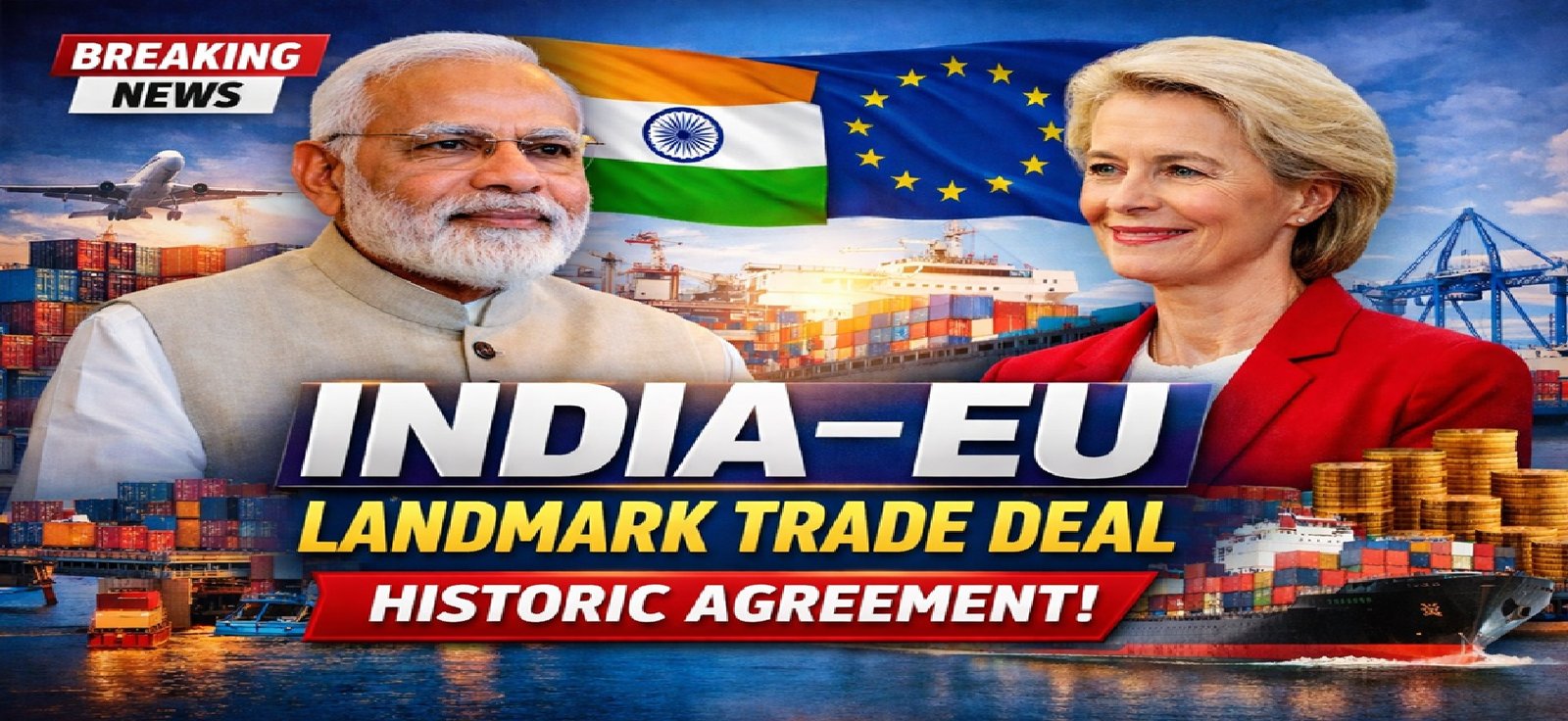
India–EU Landmark Trade Deal: A Historic Free Trade Agreement Set to Transform Bilateral Commerce
India–EU Landmark Trade Deal: A Historic Free Trade Agreement Set to Transform Bilateral Commerce
India–EU Landmark Trade Deal: India and the European Union have finalized a long-pending free trade deal that slashes tariffs on most goods, unlocks massive market opportunities, and deepens economic cooperation. Learn what the pact means for trade, industries, consumers, and global supply chains.
India–EU Landmark Trade Deal: A New Era in Bilateral Trade
Amit Kaul – For Business Desk, Bengaluru: January 28, 2026 — After nearly two decades of negotiations, India and the European Union (EU) have reached a historic Free Trade Agreement (FTA) that promises to reshape economic ties between the world’s fastest-growing major economy and the largest trading bloc in the world. The announcement, formally concluded on January 27, 2026, was hailed by leaders from both sides as a major diplomatic and economic milestone, potentially catalyzing new growth trajectories and strategic cooperation across sectors.
https://digitalamitkaul.online/eu-india-summit-2026-joint-statement-new-delhi-2/
This agreement — widely referred to in media as the “mother of all deals” — will eliminate or drastically reduce tariffs on the vast majority of goods traded between India and the EU, opening guarded markets and deepening integration in global supply chains.
Ambitious Tariff Reductions and Market Access
Under the terms of the deal, tariff barriers on over 96 % of goods by value between India and the EU are set to be either removed or significantly reduced. This includes a wide array of categories such as machinery, chemicals, textiles, gems and jewellery, and marine products, among others. For European exporters, this represents one of the most significant openings into a traditionally protected Indian market.
Perhaps most striking are the changes in the automobile sector. Tariffs on EU-manufactured cars previously as high as 110 % will be gradually phased down to around 10 % over a specified timeline. Such a reduction positions the Indian market as significantly more accessible to European automakers — including luxury and premium brands.
Significant tariff reductions will also help alcoholic products like wines and spirits, which were subject to high taxes in India. For example, charges on wines will first drop from 150% to 75% and then progressively decrease in subsequent years. These sweeping changes mark a clear departure from decades of shielded trade practices and protectionist tariff regimes.
India–EU Landmark Trade Deal: What the Deal Means for India
For India, the FTA enhances access to the massive EU market of about 450 million consumers, under preferential tariff conditions. Indian exporters will see over 99 % of their goods gain preferential treatment in EU markets, strengthening exports of textiles, leather goods, chemicals, marine products, and gems and jewellery.
Industry bodies are already optimistic. The gem and jewellery sector, for example, expects exports to the EU to double to nearly $10 billion over the next few years, thanks to tariff elimination on key product lines.
The agreement is also expected to support engineering exports and other manufactured goods, potentially lifting overall export figures significantly in the coming years.
India–EU Landmark Trade Deal: Strategic and Economic Implications
Beyond tariff cuts, the India–EU FTA embeds broader economic and strategic benefits:
Services and Investment: The pact includes provisions that strengthen cooperation in the services sector and unlock preferential investment opportunities on both sides of the partnership.
Customs and Regulatory Cooperation: Simplified customs procedures and enhanced regulatory alignment aim to ease cross-border trade flows and reduce non-tariff barriers over time.
Skilled Mobility: Frameworks that facilitate mobility for professionals, intracorporate transferees, and skilled workers are part of the broader collaboration, introducing potential benefits for labour markets and talent exchange.
Sustainability and Green Tech: Both parties highlighted cooperation in clean technology, decarbonization support, and sustainable development initiatives, including financial incentives to help India transition to greener industrial practices.
Strategists view the FTA as a critical diversification strategy amid shifting global trade dynamics, especially with rising protectionist policies in other major markets.
https://aamnewsnetwork.com/davos-2026-changing-global-order/
India–EU Landmark Trade Deal: Implementation Timeline and Next Steps
Although the deal has been finalized in principle, it still requires legal vetting and ratification by all EU member states, the European Parliament, and the Indian cabinet before it can come into force. Officials estimate that the pact could be implemented within the next year if approvals proceed as planned.
Once operational, the agreement is projected to increase bilateral trade from current levels toward new highs, strengthen economic linkages, and set a precedent for similar ambitious trade frameworks elsewhere.
Conclusion
The India–EU landmark trade deal stands as one of the most consequential economic agreements of the decade. It not only promises to reshape bilateral commerce but also sets a strategic foundation for future cooperation in services, investment, sustainability, and shared economic growth. As legal and parliamentary processes unfold, businesses, policymakers, and market watchers around the world will be closely watching how this pact translates into tangible economic outcomes in the years ahead.
Author Bio
Amit Kaul is a professional content writer and digital news strategist based in Bengaluru (India). With over a decade of experience covering transportation, technology, and travel, Amit specializes in creating SEO-optimized, engaging news content for digital platforms. He focuses on in-depth reporting, trend analysis, and reader-friendly storytelling, ensuring articles reach a global audience effectively.


Pingback: Indian Rupee Hits All-Time Low Near ₹92 Against US Dollar - DNN
Pingback: India’s Economic Momentum Continues as Survey Signals Strong Growth Path for FY26 - DNN
Pingback: Forex Reserves Surge to $709.41 Billion: India Strengthens Capital Stability - ANN