
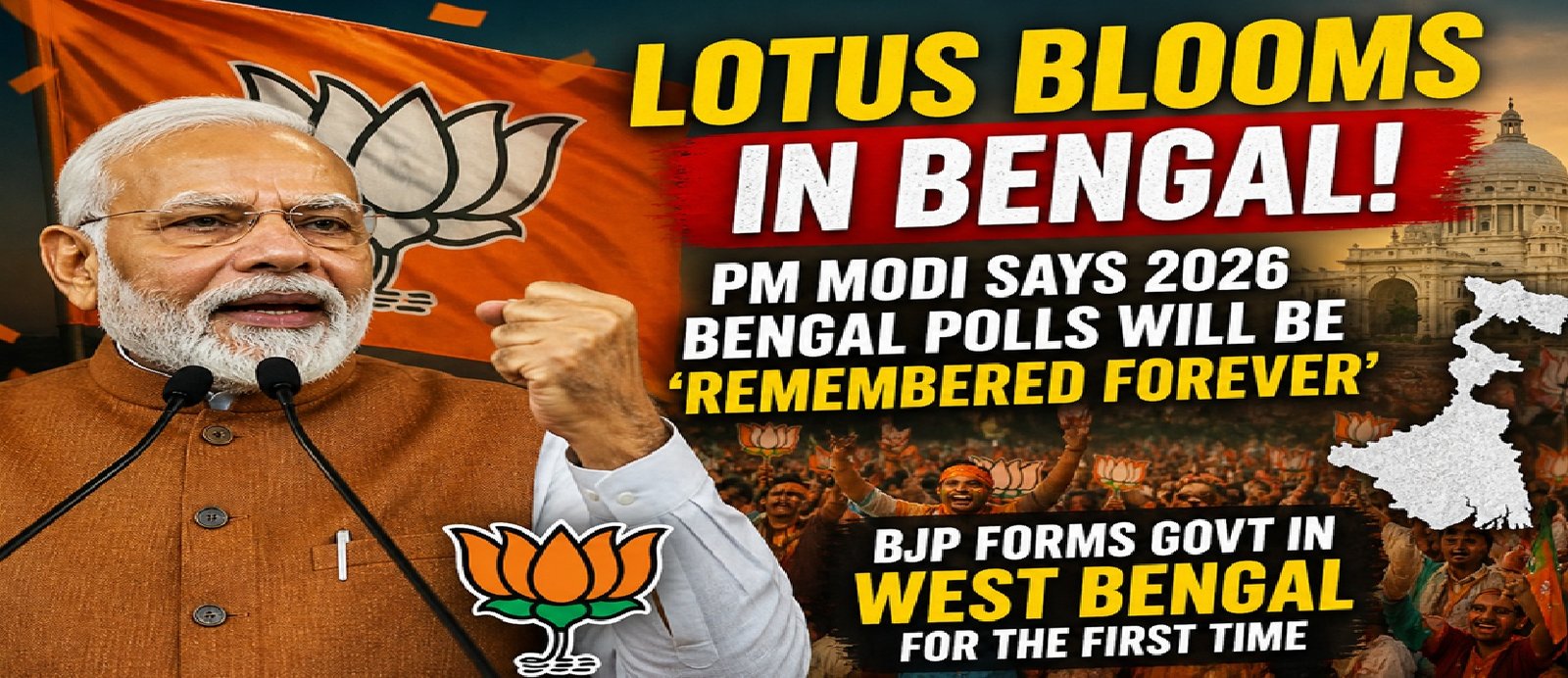
Lotus Blooms in Bengal: How BJP’s Historic 2026 Victory Reshapes State Politics and National Power Dynamics
Lotus Blooms in Bengal: How BJP’s Historic 2026 Victory Reshapes State Politics and National Power Dynamics
Lotus Blooms in Bengal: PM Narendra Modi hails the BJP’s historic win in the West Bengal Election 2026. An in-depth analysis of what led to this political shift, its impact on governance, and national implications.
Lotus Blooms in Bengal: A Defining Political Moment
Amit Kaul – For Digital Desk, Bengaluru: May 4, 2026 – Prime Minister Narendra Modi has termed the Bharatiya Janata Party’s (BJP) victory in the 2026 West Bengal Assembly elections as a moment that will be “remembered forever.” His statement is not mere political rhetoric—it signals a tectonic shift in one of India’s most politically complex and historically resistant states. For the first time since independence, the BJP has managed to form a government in West Bengal, breaking decades of regional political dominance.
This victory carries implications that extend far beyond state borders. It is not just an electoral win—it is a structural transformation in the political landscape of eastern India.
https://digitalamitkaul.online/west-bengal-politics-history-2026-election-analysis/
Lotus Blooms in Bengal: Breaking a Long-Standing Political Fortress
For decades, West Bengal’s politics has been shaped by strong regional forces—from Left Front dominance to the rise of the All India Trinamool Congress under Mamata Banerjee. The BJP’s inability to convert its growing vote share into power in earlier elections had often been attributed to Bengal’s unique socio-political fabric, rooted in regional identity, linguistic pride, and welfare-driven governance.
However, the 2026 verdict suggests that these entrenched political equations have undergone a decisive shift. BJP’s rise in Bengal has been gradual but consistent—starting from a marginal presence to becoming the principal opposition, and now, the ruling party.
Factors Behind BJP’s Breakthrough
Several factors contributed to this historic outcome:
1. Organizational Deepening
The BJP invested heavily in grassroots expansion, building a robust booth-level network across rural and urban constituencies. Party workers, whom Modi specifically credited in his message, played a critical role in voter mobilization and narrative-building.
2. Narrative of Governance
The Prime Minister emphasized “politics of good governance” as a key pillar of the BJP’s campaign. The party positioned itself as an alternative to what it described as administrative stagnation and corruption under previous regimes. This messaging appears to have resonated with sections of voters seeking change.
3. Polarization and Identity Politics
While development remained central, identity politics also played a significant role. BJP’s ideological positioning and targeted outreach to specific communities helped consolidate its vote base, particularly in regions where it had previously struggled.
4. Anti-Incumbency Wave
After years of rule by the Trinamool Congress, signs of voter fatigue were evident. Allegations related to governance, law and order, and corruption created an environment conducive to political change.
Lotus Blooms in Bengal: Modi’s Messaging: More Than Celebration
In his statement on X, Modi not only celebrated the victory but also framed it as a validation of the BJP’s governance model. His assurance that the new government will fulfil the “dreams and aspirations” of Bengal’s people is strategically significant.
This messaging serves multiple purposes:
- It reassures voters who may have been skeptical of the BJP’s ability to govern Bengal.
- It sets expectations for performance-driven governance.
- It reinforces the BJP’s national narrative of development-oriented politics.
Implications for West Bengal
The immediate question is how governance in Bengal will evolve under the BJP leadership. Key areas to watch include:
- Administrative Reforms: Whether the BJP can deliver on its promise of transparent governance.
- Economic Policy: Industrial revival, investment inflow, and job creation will be critical benchmarks.
- Social Cohesion: Managing Bengal’s diverse social fabric without escalating tensions will be a major challenge.
The transition from opposition to governance is often the most difficult phase for any political party, particularly in a state with entrenched administrative systems and strong political identities.
National Political Impact
The significance of this victory extends beyond Bengal. It strengthens the BJP’s footprint in eastern India, a region that has historically been less receptive to the party compared to northern and western states.
From a national perspective:
- It boosts the BJP’s momentum ahead of future general elections.
- It weakens the opposition’s narrative of regional strongholds resisting BJP expansion.
- It enhances Modi’s image as a leader capable of breaking political barriers.
For opposition parties, especially the Trinamool Congress, this result could trigger introspection and strategic recalibration.
Lotus Blooms in Bengal: Challenges Ahead for BJP
Despite the celebratory tone, the road ahead is far from easy. The BJP government will face multiple challenges:
- Delivering quick and visible governance outcomes
- Managing expectations of a diverse voter base
- Navigating administrative resistance
- Avoiding political overreach that could alienate regional sentiments
- Failure to address these issues could impact the party’s long-term prospects in the state.
Conclusion: A Political Watershed Moment
The 2026 West Bengal election marks a watershed moment in Indian politics. Prime Minister Narendra Modi’s assertion that this victory will be “remembered forever” reflects its historical significance.
However, the real test begins now. Electoral success must translate into governance success. If the BJP manages to deliver on its promises, this victory could redefine Bengal’s political trajectory for decades. If not, it risks being remembered as a fleeting disruption rather than a lasting transformation.
https://aamnewsnetwork.com/bihar-election-2025-nitish-kumar-man-of-the-match-women-voters-nda-surge/
In either case, one thing is clear: the lotus has bloomed in Bengal—and Indian politics will not remain the same.
Author Bio
Amit Kaul is a professional content writer and digital news strategist based in Bengaluru (India). With over a decade of experience covering transportation, technology, and travel, Amit specializes in creating SEO-optimized, engaging news content for digital platforms. He focuses on in-depth reporting, trend analysis, and reader-friendly storytelling, ensuring articles reach a global audience effectively.



Pingback: Bengal CM Race Heats Up: BJP’s Landslide Victory Triggers High-Stakes Leadership Battle Ahead of May 9 Swearing-In - ANN
Pingback: Major Security Breach Before PM Modi’s Bengaluru Visit: Explosive Material Found Near Event Venue Sparks Alarm - DNN
Pingback: PM Modi Shrinks Official Convoy to Just Two Vehicles Amid Fuel Conservation Push - ANN