
US Military Dominance Under Threat? China Leads in Three Key Categories
US Military Dominance Under Threat? China Leads in Three Key Categories
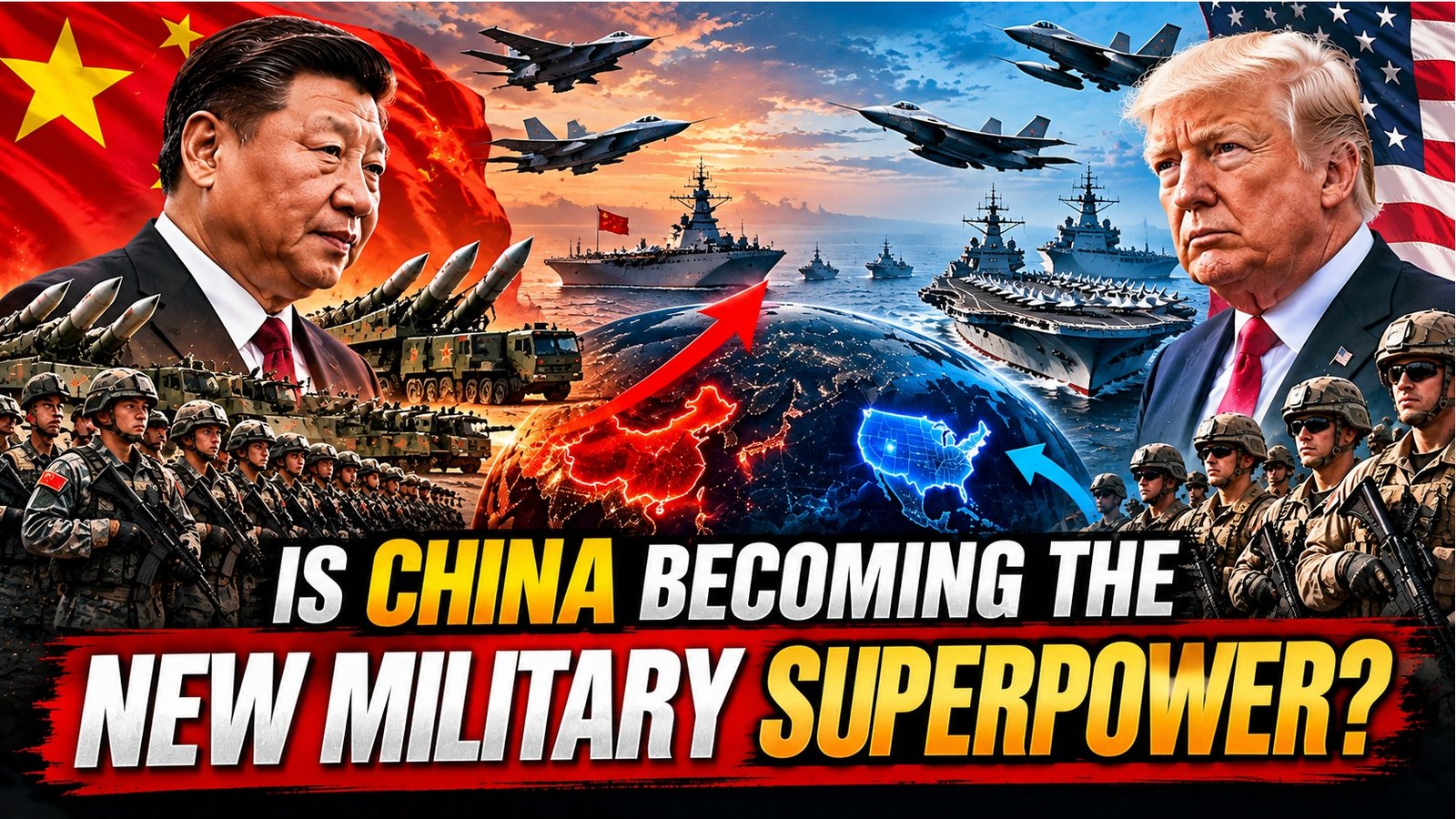
US Military Dominance Under Threat? The 2026 Global Firepower rankings reveal China’s growing troop, tank, and naval strength as America retains the top spot.
China Challenges American Military Dominance, but Who Is Really Number One?
Amit Kaul – For Digital Desk, Bengaluru: October 31, 2026 – For decades, the United States has been regarded as the world’s dominant military power, capable of deploying aircraft carriers, fighter jets, submarines, and troops thousands of miles from home. But a new comparison of global military capabilities suggests that America’s advantage is no longer universal. China has overtaken the United States in several important measures of military size, including active-duty personnel, tanks, and the number of naval vessels.
The findings, highlighted in an October 23, 2026, analysis by Visual Capitalist, draw on the latest Global Firepower military data. However, there is an important distinction: China leads in several numerical categories, but the United States remains the world’s highest-ranked military power overall. The findings raise a consequential question for global security: Could China’s expanding military eventually challenge America’s ability to dominate conflicts, particularly in the Indo-Pacific?
https://digitalamitkaul.online/ukraine-missile-strike-russian-airfield-six-su34m-jets-destroyed/
World’s 10 Most Powerful Militaries in 2026
According to the 2026 Global Firepower rankings, the United States retains first place among 145 countries assessed using more than 60 factors, including manpower, equipment, logistics, finances, and geography.
Rank Country PowerIndex
1 United States 0.0741
2 Russia 0.0791
3 China 0.0919
4 India 0.1346
5 South Korea 0.1642
6 France 0.1798
7 Japan 0.1876
8 United Kingdom 0.1881
9 Türkiye 0.1975
10 Italy 0.2211
Source: Global Firepower 2026. A lower PowerIndex score indicates a stronger estimated conventional military capability. The index is a model, not a prediction of victory in war.
The United States leads the rankings, followed by Russia and China. India retains fourth place, while South Korea completes the top five. The rankings also reflect the growing military importance of European and Asian powers, including France and Japan.
US Military Dominance Under Threat: China Leads in Troops, Tanks and Naval Assets
Visual Capitalist’s October 23 comparison identifies China as the leader in three of four measures: active military personnel, tanks and naval assets. China’s substantial manpower provides an advantage in the potential scale of ground operations, while its shipbuilding capacity has supported rapid naval expansion.
Global Firepower’s 2026 comparison lists China with 841 naval assets against 465 for the United States. But counting ships alone does not establish naval superiority. The American fleet includes 11 aircraft carriers compared with China’s three, according to the same database. The United States also maintains a substantial advantage in destroyers and carrier-based global power projection.
China’s growing fleet is particularly relevant to the Taiwan Strait and South China Sea, where proximity to Chinese military bases could influence a potential conflict. The United States, meanwhile, must maintain forces across multiple regions, including Europe, the Middle East and the Pacific. This difference between regional concentration and worldwide military reach is essential to understanding the strategic competition.
America Still Dominates Global Airpower
Despite China’s advances, the United States maintains an extraordinary advantage in military aviation. Visual Capitalist reports that America possesses approximately 13,032 military aircraft—more than the combined inventories of Russia, China, India and South Korea. That advantage reflects decades of investment in fighters, bombers, transport aircraft, aerial refuelling and other aviation capabilities.
However, the total number of aircraft does not automatically translate into combat superiority. Modern warfare increasingly depends on stealth technology, electronic warfare, intelligence networks, long-range missiles, maintenance capacity and the ability to operate in heavily defended airspace.
China’s expanding air force and missile capabilities could complicate American operations close to the Chinese mainland, even if the United States retains a much larger aircraft inventory overall.
US Military Dominance Under Threat: Russia Remains a Major Military Power Despite the Ukraine War
Russia’s second-place ranking may surprise observers given the extensive military losses and operational challenges associated with its war in Ukraine. Yet Russia continues to possess significant conventional forces, a substantial defence-industrial base and one of the world’s largest nuclear arsenals.
Its strategic influence cannot be measured through conventional equipment inventories alone. At the same time, the Ukraine conflict demonstrates why military rankings require careful interpretation. A country may possess enormous military resources without achieving its political or territorial objectives quickly.
Battlefield performance depends on command structures, logistics, training, intelligence, morale, and the ability to sustain operations over time. Russia’s experience reinforces a broader lesson: military size and military effectiveness are related, but they are not identical.
India’s Military Strength Makes It a Major Global Player
India’s fourth-place position is particularly significant as competition between Washington and Beijing intensifies. With a PowerIndex score of 0.1346, India remains among the world’s leading conventional military powers.
Its strategic position in the Indian Ocean, substantial armed forces and expanding domestic defence industry make it an important participant in the evolving security architecture of Asia. India also faces a complex security environment involving its borders with China and Pakistan, requiring considerable resources for territorial defence.
New Delhi’s military modernisation programmes, including investments in fighter aircraft, naval capabilities, missiles and indigenous defence production, reflect its ambition to strengthen strategic autonomy.
For Washington, India’s military capabilities are strategically relevant to maintaining a regional balance of power. However, India pursues an independent foreign policy rather than operating as a formal American military ally.
Could China Defeat the United States in a Future Conflict?
The possibility of a direct military confrontation between China and the United States remains one of the most consequential security concerns of the modern era.
Taiwan represents a particularly sensitive potential flashpoint. China’s geographic proximity, missile capabilities, and growing naval forces could create serious operational challenges for American forces responding to a regional crisis.
Nevertheless, defeating the United States militarily would be an entirely different proposition from surpassing it in troop numbers or ship counts. America benefits from extensive overseas military infrastructure, advanced military technology, powerful naval aviation and defence relationships with countries including Japan, South Korea and Australia.
China, meanwhile, has advantages in proximity to potential regional conflict zones and the ability to concentrate military resources near its own territory. A direct conflict would carry enormous risks for both countries, including economic disruption, substantial casualties and the possibility of escalation involving nuclear-armed states. There is no credible basis for treating a Chinese victory—or an American victory—as inevitable.
Is the United States Losing Its Military Superpower Status?
The 2026 Global Firepower findings reveal an important transformation in the international security environment. The United States no longer possesses the largest inventory in every military category, and China’s rapid expansion has narrowed some important gaps.
But the evidence does not show that China has already replaced America as the world’s strongest military power. Global Firepower still ranks the United States first, Russia second, and China third.
Furthermore, its assessment primarily measures conventional military potential. It cannot fully capture the complexities of combat readiness, operational experience, alliance commitments, nuclear deterrence, or wartime decision-making.
The ongoing confrontation involving the United States and Iran also illustrates the limitations of equating superior military capabilities with the achievement of political objectives. Claims about the conflict’s outcome or an alleged American defeat require separate evidence and should not be inferred from military rankings.
https://aamnewsnetwork.com/putin-arctic-nato-tensions-russia-respond-in-kind/
The Bottom Line: A New Era of Military Competition
The world’s military balance is changing, but it has not yet produced a clear successor to the United States. China’s lead in active personnel, tanks, and naval asset counts demonstrates the scale of its military expansion. Russia retains formidable military capabilities, while India continues to consolidate its position as a major defence power.
America, however, maintains significant advantages in airpower, aircraft carriers and global military reach. The central story of 2026 is therefore not that China has already overtaken the United States, but that American military dominance faces increasingly serious competition.
For policymakers in Washington, Beijing and New Delhi, the challenge will be managing that competition without allowing military rivalry to escalate into a catastrophic confrontation.
Author Bio
Amit Kaul is a professional content writer and digital news strategist based in Bengaluru (India). With over a decade of experience covering transportation, technology, and travel, Amit specializes in creating SEO-optimized, engaging news content for digital platforms. He focuses on in-depth reporting, trend analysis, and reader-friendly storytelling, ensuring articles reach a global audience effectively.


