
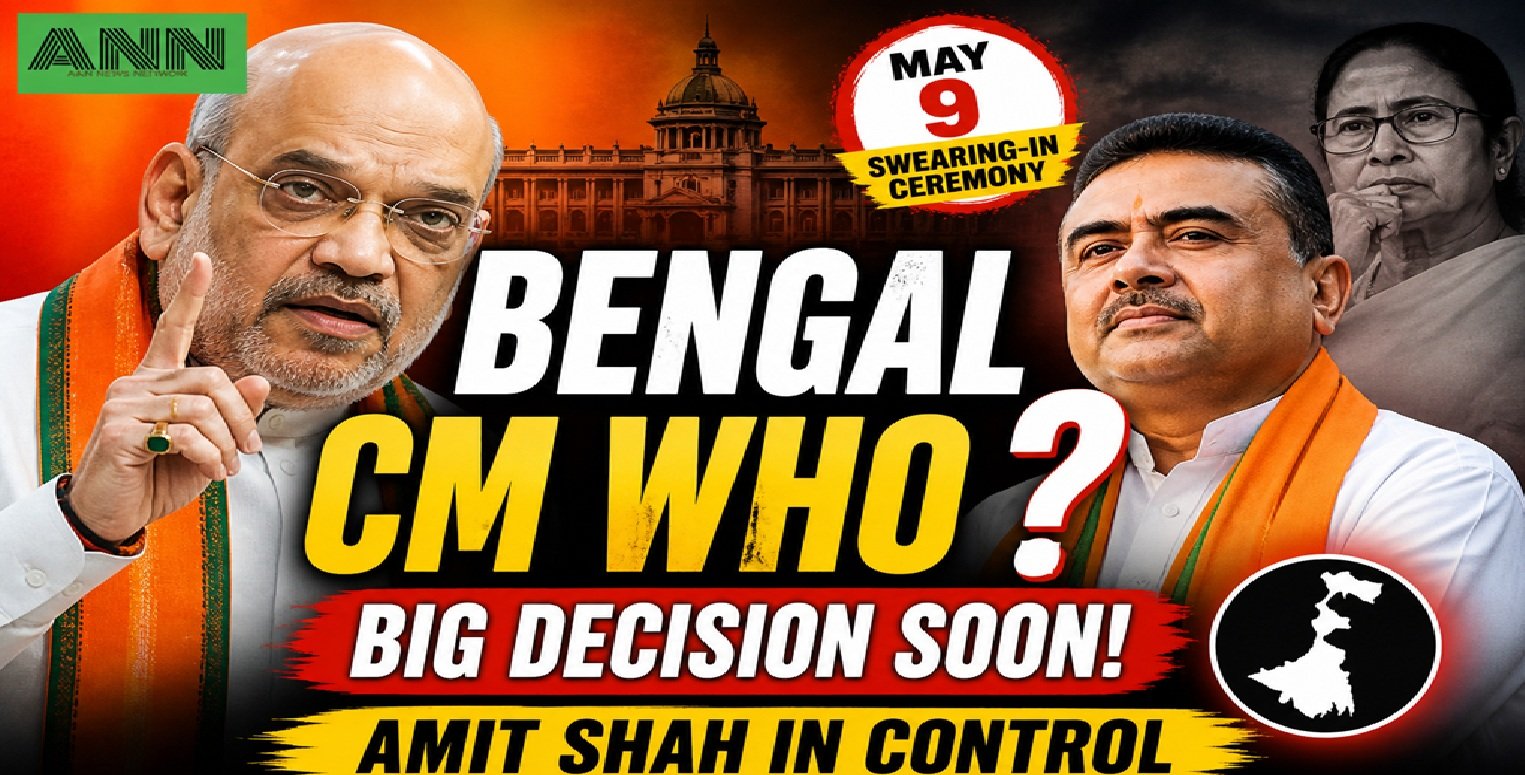
Bengal CM Race Heats Up: BJP’s Landslide Victory Triggers High-Stakes Leadership Battle Ahead of May 9 Swearing-In
Bengal CM Race Heats Up: BJP’s Landslide Victory Triggers High-Stakes Leadership Battle Ahead of May 9 Swearing-In
Bengal CM Race Heats Up: After a decisive BJP victory in Bengal, Amit Shah has been appointed observer to finalize the CM candidate. Will Suvendu Adhikari take charge? Full political analysis.
Bengal CM Race Intensifies as BJP Moves Swiftly After Historic Victory
Amit Kaul – For Digital Desk, Bengaluru: May 5, 2026 – The political landscape of West Bengal has entered a decisive and high-voltage phase following the Bharatiya Janata Party’s (BJP) sweeping electoral victory. With the mandate firmly in its favor, the party has shifted focus from campaigning to consolidation, initiating rapid steps toward government formation. At the center of this transition is Union Home Minister Amit Shah, who has been appointed as the central observer for West Bengal—a move that underscores the strategic importance the BJP attaches to leadership selection in the state.
Simultaneously, the party has appointed J. P. Nadda as the observer for Assam, indicating a coordinated and centralized approach to leadership decisions in key states. These appointments are not merely procedural; they signal the BJP’s intent to ensure stability, discipline, and alignment with the party’s national vision as it prepares to form governments in both regions.
https://aamnewsnetwork.com/bjp-historic-win-west-bengal-election-2026-modi-analysis/
Bengal CM Race Heats Up: Why the Observer Role Matters in the BJP’s Political Framework
In the BJP’s organizational structure, the appointment of observers is a critical mechanism during government formation. Observers act as the high command’s emissaries, tasked with consulting newly elected legislators, gauging internal dynamics, and ensuring consensus in the selection of the Chief Minister.
The choice of Amit Shah for West Bengal is particularly significant. Known for his organizational acumen and electoral strategy, Shah’s involvement suggests that the party is keen to avoid factionalism and project a unified leadership face. His decisions are likely to be guided not only by legislative arithmetic but also by long-term political calculations, including governance capability, caste and regional representation, and electoral sustainability.
Suvendu Adhikari: Frontrunner or Strategic Decoy?
Among the names circulating in political corridors, Suvendu Adhikari has emerged as the most prominent contender for the Chief Minister’s post. His political trajectory—from a key figure in the Trinamool Congress to a BJP heavyweight—has been marked by strategic shifts and electoral significance.
Adhikari’s victory over incumbent Chief Minister Mamata Banerjee is being interpreted as a symbolic and structural turning point in Bengal politics. It not only reflects voter dissatisfaction with the previous regime but also establishes Adhikari as a leader capable of challenging entrenched political forces.
However, the BJP’s history suggests that frontrunners are not always the final choice. The party often opts for leaders who balance administrative experience with broader acceptability. Therefore, while Adhikari remains a strong candidate, the final decision will likely emerge from a complex matrix of political considerations.
Bengal CM Race Heats Up: Strategic Co-Observers Signal Federal Coordination
The appointment of Odisha Chief Minister Mohan Charan Majhi as co-observer for West Bengal and Haryana Chief Minister Nayab Singh Saini for Assam reflects the BJP’s emphasis on inter-state coordination and governance benchmarking.
These co-observers bring administrative experience and regional insights, which can help in assessing leadership capabilities and governance priorities. Their presence also indicates that the BJP is looking beyond immediate political gains, aiming to establish governance models that can be replicated across states.
May 9 Swearing-In: A Deadline That Shapes Decisions
The announcement of May 9 as the date for the swearing-in ceremony adds urgency to the decision-making process. With limited time, the BJP leadership must finalize its choice swiftly while ensuring that the selected leader can command legislative support and public confidence.
This compressed timeline increases the likelihood of a decisive intervention by Amit Shah, whose role will be pivotal in resolving any internal disagreements and presenting a unified leadership front.
Assam Parallel: A Mirror Strategy
While West Bengal remains the focal point, the BJP’s approach in Assam mirrors its broader strategy. The appointment of J. P. Nadda as observer and Nayab Singh Saini as co-observer indicates a standardized framework for leadership selection.
This parallel process highlights the BJP’s institutionalized approach to governance transitions, reducing uncertainty and reinforcing central leadership control.
Bengal CM Race Heats Up: The Larger Political Implications
The outcome of the CM selection in West Bengal will have ramifications beyond the state. A strong and effective leadership choice could consolidate the BJP’s position in eastern India, a region that has historically been resistant to its expansion.
Moreover, the decision will serve as a signal to party cadres and opposition alike regarding the BJP’s governance priorities and political strategy. Whether the party opts for a mass leader like Suvendu Adhikari or a consensus candidate, the choice will reflect its broader vision for Bengal.
Conclusion: A Decisive Moment in Bengal Politics
As the countdown to May 9 begins, West Bengal stands at a political crossroads. The BJP’s victory has created an opportunity for a political reset, but the success of this transition will depend heavily on leadership selection.
https://digitalamitkaul.online/west-bengal-election-2026-mamata-banerjee-defeat-bjp-rise-analysis/
With Amit Shah at the helm of the decision-making process, expectations are high for a calculated and strategic choice. The coming days will not only determine who becomes Bengal’s next Chief Minister but also shape the trajectory of the state’s political and governance landscape for years to come.
Author Bio
Amit Kaul is a professional content writer and digital news strategist based in Bengaluru (India). With over a decade of experience covering transportation, technology, and travel, Amit specializes in creating SEO-optimized, engaging news content for digital platforms. He focuses on in-depth reporting, trend analysis, and reader-friendly storytelling, ensuring articles reach a global audience effectively.



Pingback: Professional Hit or Political Message? Inside the Chilling Murder of Suvendu Adhikari’s PA in Madhyamgram - DNN
Pingback: BJP’s ‘Sonar Bangla’ Era Begins: Suvendu Adhikari Sworn In as West Bengal Chief Minister - ANN