
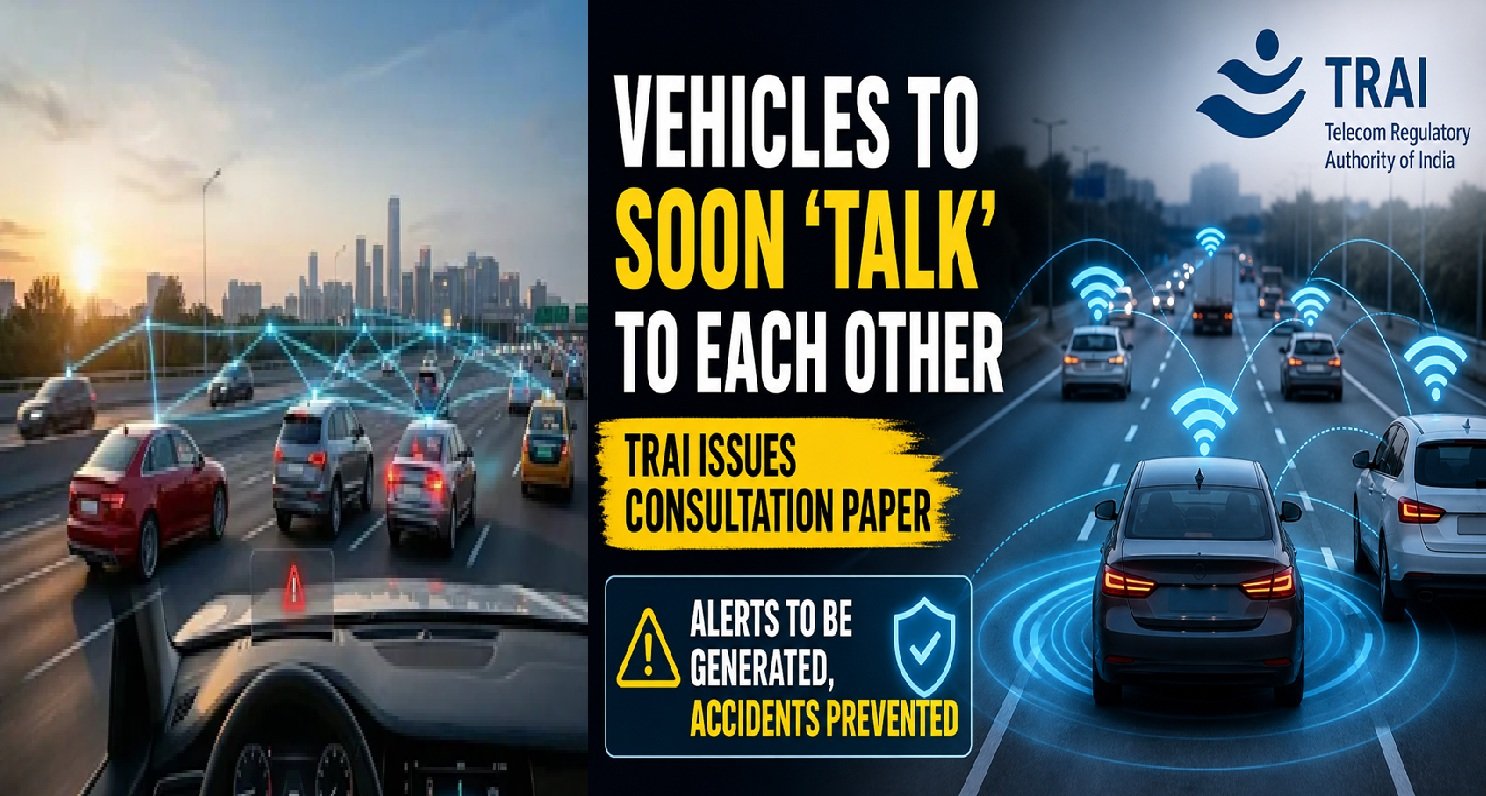
V2X in India: How TRAI’s Consultation Could Make Vehicles “Talk” — And Drastically Cut Road Accidents
V2X in India: How TRAI’s Consultation Could Make Vehicles “Talk” — And Drastically Cut Road Accidents
V2X in India: TRAI’s new consultation paper on Vehicle-to-Everything (V2X) technology could transform India’s roads with real-time alerts, smarter traffic systems, and safer driving. Here’s a deep analysis.
Vehicles to Soon “Talk” to Each Other: A Turning Point for India’s Road Safety Ecosystem
Amit Kaul – For Digital Desk, Bengaluru: May 1, 2026 –India may be on the cusp of a major mobility transformation. With the Telecom Regulatory Authority of India (TRAI) releasing a consultation paper on Vehicle-to-Everything (V2X) communication, the country is taking a decisive step toward building an intelligent, interconnected transport ecosystem. At its core, this initiative is not just about technological advancement—it is about saving lives, optimizing infrastructure, and preparing India for the era of autonomous mobility.
https://digitalamitkaul.online/artificial-intelligence-impact-jobs-industries-2026/
V2X in India – Policy Trigger: Why TRAI Stepped In
The move originates from a formal request by the Department of Telecommunications (DoT) on December 1, 2025, asking TRAI to frame a regulatory structure for V2X under the TRAI Act, 1997. This is significant because V2X sits at the intersection of telecom, automotive engineering, and public infrastructure—requiring coordinated policy oversight rather than fragmented regulation.
The consultation paper now invites inputs from stakeholders until May 28, 2026, with counter-comments open until June 11, 2026. This participatory approach signals that India intends to build a consensus-driven framework, rather than imposing a top-down mandate.
What Exactly is V2X — And Why It Matters
Vehicle-to-Everything (V2X) is an umbrella communication architecture that enables vehicles to exchange data with:
- Other vehicles (V2V)
- Road infrastructure like signals (V2I)
- Pedestrians and devices (V2P)
- Networks/cloud systems (V2N)
This real-time data exchange creates a dynamic awareness layer around every vehicle. Imagine a car receiving alerts about a sudden brake event two vehicles ahead, or a blind intersection warning triggered by infrastructure sensors—before the driver can even visually react.
In technical terms, V2X relies on low-latency wireless communication protocols, often leveraging 5G networks or dedicated short-range communications (DSRC). The key requirement is ultra-reliable, near-instantaneous data transmission.
V2X in India – The Safety Dividend: From Reaction to Prediction
India records one of the highest numbers of road fatalities globally. Traditional safety systems—like airbags or ABS—are reactive. V2X, by contrast, is predictive.
By enabling vehicles to “talk,” the system can:
- Issue collision warnings in milliseconds
- Detect blind spots and hidden hazards
- Alert drivers about sudden lane changes or braking
- Warn about pedestrians or cyclists in proximity
This predictive capability could fundamentally reduce accident rates, especially in high-density urban corridors and highways.
Traffic Management: Beyond Just Safety
The implications go beyond accident prevention. V2X can dramatically improve traffic efficiency:
- Adaptive Traffic Signals: Signals can adjust in real time based on vehicle density.
- Reduced Congestion: Vehicles can reroute dynamically based on live conditions.
- Emergency Prioritization: Ambulances and fire services can get signal priority automatically.
For a country like India, where congestion costs billions in lost productivity annually, this could be a game-changer.
V2X in India – Enabler for Autonomous Vehicles
V2X is widely regarded as a foundational layer for autonomous driving. While onboard sensors like LiDAR and cameras provide localized awareness, V2X extends visibility beyond line-of-sight.
For example, a self-driving car cannot “see” around a corner—but V2X can inform it of an oncoming vehicle or obstruction. This hybrid intelligence—sensor + network—is essential for safe autonomy.
Thus, TRAI’s move is not just about current mobility challenges; it is a long-term bet on India’s readiness for self-driving ecosystems.
Regulatory and Technical Challenges Ahead
Despite its promise, V2X deployment is complex. TRAI’s consultation is expected to address several critical issues:
1. Spectrum Allocation
V2X requires dedicated spectrum bands. The debate often revolves around whether to allocate spectrum exclusively for automotive safety or share it with telecom services.
2. Standardization
Global fragmentation exists between DSRC (favored in the US) and C-V2X (cellular-based, backed by 5G ecosystems). India must choose a standard that aligns with its digital infrastructure strategy.
3. Data Privacy & Cybersecurity
Continuous data exchange raises concerns about surveillance and hacking. A compromised V2X system could have catastrophic consequences.
4. Infrastructure Readiness
Deploying roadside units, smart signals, and network integration will require substantial public and private investment.
5. Industry Coordination
Automakers, telecom providers, and government bodies must operate within a unified framework—something that has historically been challenging in India’s regulatory landscape.
Industry Impact: A New Mobility Economy
If implemented effectively, V2X could unlock new economic opportunities:
- Smart mobility startups
- Advanced telematics services
- AI-driven traffic analytics
- Insurance models based on real-time driving behavior
It could also accelerate India’s ambitions under initiatives like Digital India and Smart Cities Mission.
V2X in India – Strategic Timing: Why This Matters Now
The timing of this consultation is critical. With 5G networks expanding across India, the underlying infrastructure for V2X is becoming viable. At the same time, global automotive markets are rapidly moving toward connected and autonomous vehicles.
If India delays, it risks becoming a passive consumer of imported technologies. By acting now, it can shape standards, build domestic capabilities, and lead in emerging mobility paradigms.
Conclusion: From Consultation to Transformation
TRAI’s consultation paper is more than a regulatory exercise—it is the blueprint for a safer, smarter, and more connected transportation future. However, the real test lies in execution: aligning policy, technology, and infrastructure within a coherent national strategy.
If done right, V2X could mark a paradigm shift—from isolated vehicles navigating chaotic roads to an intelligent network of communicating systems working in harmony. In a country where road safety is a pressing crisis, that shift cannot come soon enough.
Author Bio
Amit Kaul is a professional content writer and digital news strategist based in Bengaluru (India). With over a decade of experience covering transportation, technology, and travel, Amit specializes in creating SEO-optimized, engaging news content for digital platforms. He focuses on in-depth reporting, trend analysis, and reader-friendly storytelling, ensuring articles reach a global audience effectively.



Pingback: Public Sector Banks Create History with ₹1.98 Lakh Crore Profit; Strongest-Ever Financial Performance Recorded - DNN