
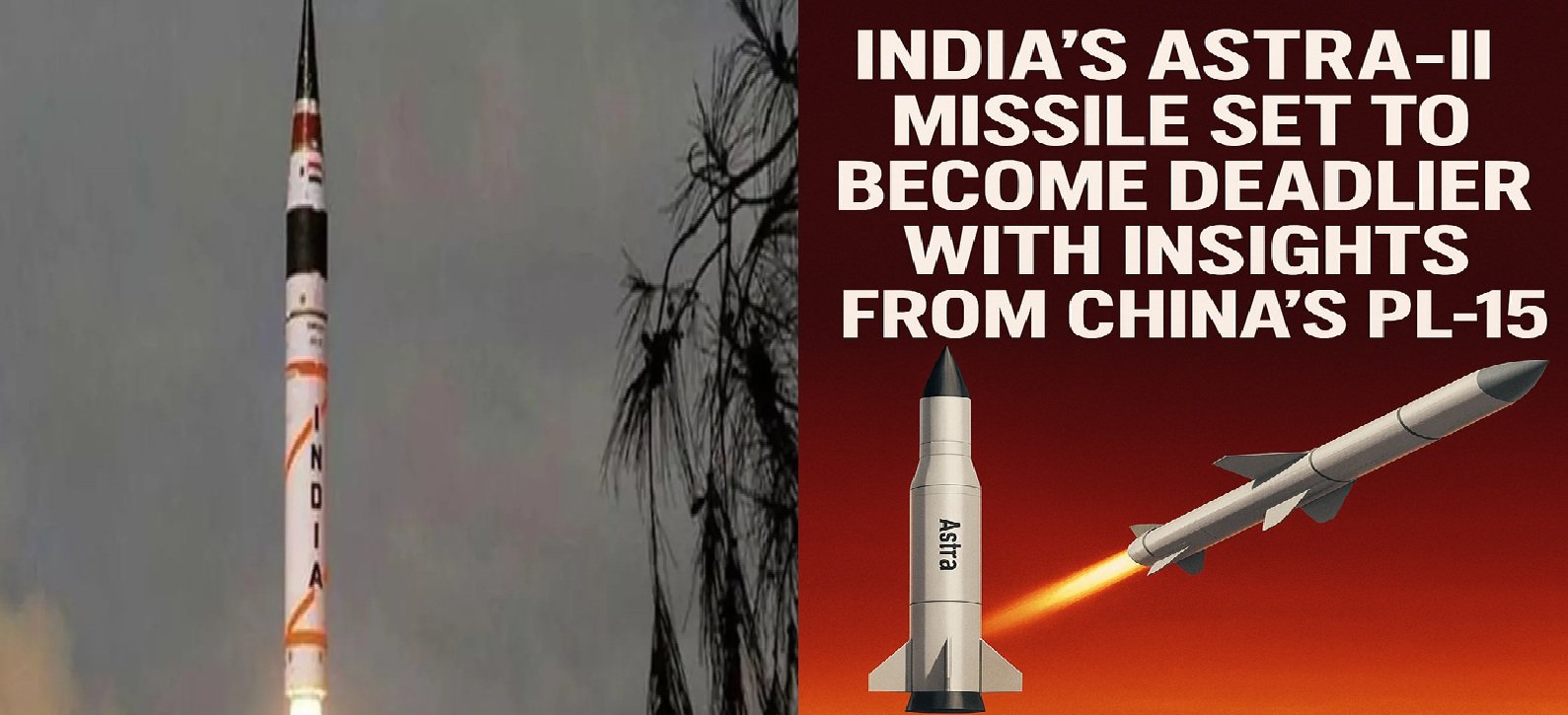
India’s Astra-II Missile Set to Become Deadlier with Insights from China’s PL-15
India’s Astra-II Missile Set to Become Deadlier with Insights from China’s PL-15
India’s Astra-II Missile: India strengthens its defense capabilities as DRDO integrates advanced features of China’s PL-15 missile into the Astra-II program, enhancing speed, radar, and anti-jamming systems.
India is taking a significant leap in its defense capabilities as the Defense Research and Development Organization (DRDO) moves to enhance the Astra Mark-2 missile by integrating advanced features derived from China’s PL-15 missile. This upgrade marks a critical step in India’s ongoing push to modernize its indigenous missile and fighter jet programs.
The development follows a rare intelligence opportunity in May 2025, when a PL-15E missile fired by Pakistan during Operation Sindoor was recovered intact from a field near Hoshiarpur, Punjab. The missile, launched from a Pakistani Air Force JF-17 or J-10C aircraft, failed to hit its target and remained unexploded due to the absence of a self-destruct mechanism. This allowed Indian defense scientists to closely analyze its technology and extract valuable insights.
https://aamnewsnetwork.com/india-night-sight-deal-659-crore-defense-upgrade/
PL-15 Missile Analysis: A Game-Changer
The PL-15E missile analysis revealed several standout features that could significantly enhance India’s missile capabilities. While DRDO has kept the full report confidential, sources familiar with the investigation told Hindustan Times that the Chinese missile boasts a miniaturized active electronically scanned array (AESA) radar, advanced propellants capable of maintaining speeds over Mach 5, and sophisticated anti-jamming technology. These innovations, especially in radar systems, are now being integrated into the Astra Mark-2 missile, paving the way for one of India’s most lethal air-to-air missiles yet.
India’s Astra-II Missile: India’s Strategic Edge
With these upgrades, India is strengthening its air defense capabilities and ensuring its indigenous programs keep pace with global advancements. The Astra Mark-2 missile, now enhanced with PL-15-derived technology, promises greater range, precision, and reliability, reinforcing India’s strategic deterrence.
Regional Dynamics: Pakistan’s Arms Ambitions
Meanwhile, Pakistan continues to pursue high-tech military acquisitions. Reports indicate that the Pakistani Air Force is interested in procuring China’s long-range PL-17 missiles and 2,000 YIHA kamikaze drones from Turkey. Additionally, Pakistan has submitted a list of advanced weaponry requirements to the United States, signaling its intent to upgrade its aerial and missile capabilities.
India’s Astra-II Missile: India’s Forward Strategy
In response, India is proactively bolstering its defense arsenal. Plans include acquiring additional Meteor missiles for Rafale fighter jets to ensure numerical superiority and maintaining operational readiness. Furthermore, a next-generation BrahMos missile with an extended range of 800 kilometers is under development, capable of covering strategic targets across Pakistan.
https://digitalamitkaul.online/tejas-mk1a-maiden-flight-rajnath-singh-historic-milestone-hal/
As India continues to integrate global technologies into indigenous defense programs, the Astra Mark-2 missile represents a significant milestone in the nation’s journey toward advanced, self-reliant defense capabilities. With enhanced speed, radar precision, and anti-jamming technology, India is poised to maintain a formidable strategic edge in the region.



Pingback: India-China Border Talks Signal Hope for Peace: Will Ladakh See an End to Tensions? - DNN
Pingback: Indian NSA Ajit Doval: No Major Terror Attack in India Since 2013, Except in Jammu & Kashmir - DNN
Pingback: Gujarat ATS Exposes Shama Parveen’s Links to Pakistan Army Chief Asim Munir in Al-Qaeda Module - DNN
Pingback: Hafiz Saeed Plotting Fresh Attacks on India from Bangladesh, Says Explosive Intelligence Report - ANN