
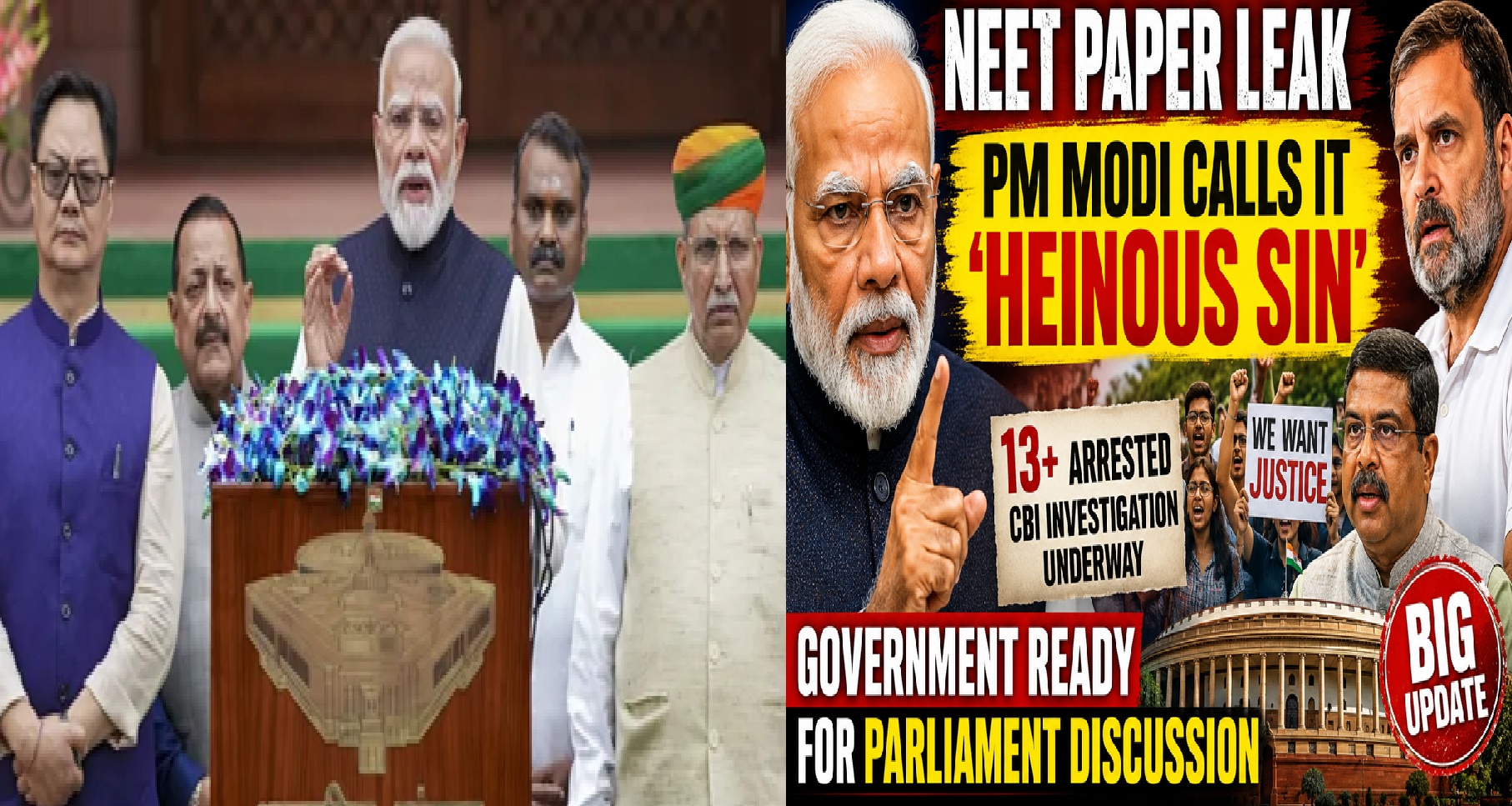
Government Ready for Parliament Debate on NEET Row as PM Modi Calls Paper Leak a “Heinous Sin”: Political Battle Intensifies
Government Ready for Parliament Debate on NEET Row as PM Modi Calls Paper Leak a “Heinous Sin”: Political Battle Intensifies
Government Ready for Parliament Debate on NEET Row – The Centre says it is ready for a detailed Parliament discussion on the NEET paper leak controversy as PM Narendra Modi calls the leak a “heinous sin.” Here’s an in-depth analysis of the political battle, the government’s response, opposition demands, and what it means for India’s education system.
Government Ready for Parliament Discussion on NEET Row as PM Modi Calls Paper Leak a “Heinous Sin”
Amit Kaul – For Digital Desk, Bengaluru: July 22, 2026 – The controversy surrounding the alleged NEET paper leak has rapidly evolved from an examination integrity issue into one of the most politically charged debates of the Monsoon Session of Parliament. With repeated disruptions in both Houses, competing narratives from the government and the opposition, and nationwide concern among students and parents, the issue has become a defining test of the government’s credibility on education governance.
As Parliament prepares to resume, the Centre has indicated that it is willing to hold a detailed discussion on the controversy. Prime Minister Narendra Modi has described the paper leak as a “ghor paap” or “heinous sin,” while simultaneously assuring the country that those responsible will face stringent punishment.
The political confrontation, however, extends beyond the investigation itself. It now encompasses questions of accountability, examination reforms, policing of student protests, and public trust in India’s competitive examination system.
https://aamnewsnetwork.com/indian-economy-gdp-growth-7-8-percent-q4-fy2025-26-analysis/
Government Ready for Parliament Debate on NEET Row -Why the NEET Controversy Has Become a National Issue
NEET is among India’s most competitive entrance examinations, determining admission to undergraduate medical courses for millions of aspirants each year.
Given the enormous stakes involved, any allegation of question paper leaks or irregularities immediately affects not just individual candidates but public confidence in the fairness of India’s higher education admissions process.
The current controversy has therefore resonated far beyond political circles, with students, parents, educators, and policy experts demanding greater transparency and stronger safeguards against examination malpractice.
Government’s Stand: Investigation Underway, Accountability Promised
Government sources have maintained that the Centre acted promptly once allegations surfaced.
According to officials:
- The Central Bureau of Investigation (CBI) is conducting a comprehensive probe.
- More than 13 accused individuals have reportedly been arrested.
- Investigations continue across multiple states.
- Authorities have pledged strict punishment for everyone found responsible.
The government has also defended Education Minister Dharmendra Pradhan, arguing that he accepted moral responsibility by initiating corrective measures immediately after the controversy emerged.
Officials have rejected opposition demands for his resignation, describing them as politically motivated rather than based on administrative accountability.
The Centre’s willingness to discuss the matter in Parliament suggests an effort to demonstrate transparency while defending its handling of the crisis.
PM Modi’s Message: Protect the Future of India’s Youth
Prime Minister Narendra Modi’s intervention has added political significance to the issue.
Calling paper leaks a “heinous sin,” he emphasized that tampering with examinations directly threatens the future of millions of young Indians.
His message contained three key themes:
- Zero tolerance for examination fraud
- The Prime Minister asserted that those involved in leaking examination papers would face strict legal consequences.
- National cooperation over political confrontation
- Rather than framing the issue as a partisan dispute, he urged both the Centre and state governments to work together in preventing examination fraud.
Government Ready for Parliament Debate on NEET Row -Protecting students
PM Modi stressed that no injustice should be done to students and warned against attempts to mislead young people during periods of public unrest.
His remarks appear intended to reassure students while projecting the government’s commitment to safeguarding examination integrity.
Opposition Sharpens Its Attack
The opposition, led by Rahul Gandhi, has adopted a far more confrontational approach.
Rahul Gandhi has accused the government of failing India’s students and demanded:
- Resignation of Education Minister Dharmendra Pradhan
- Resignation of Home Minister Amit Shah
- Parliamentary debate on the controversy
- Action against police personnel accused of manhandling protesting students
- An apology from the Prime Minister regarding the handling of demonstrations
The Congress has argued that the issue extends beyond a paper leak and reflects broader failures in governance, examination management, and protection of students’ democratic rights.
The detention of Rahul Gandhi during protests outside the Prime Minister’s residence has further intensified the political narrative surrounding the controversy.
Government Ready for Parliament Debate on NEET Row – Parliament Turns Into the Main Battleground
The Monsoon Session has already witnessed repeated disruptions as opposition members demand immediate discussion on the issue.
The government’s indication that it is prepared for a debate could potentially shift the focus from procedural protests to substantive discussion.
Such a debate is expected to cover:
- Progress of the CBI investigation.
- Security mechanisms for national examinations.
- Future reforms to prevent paper leaks.
- Administrative accountability.
- Student welfare measures.
Whether Parliament can conduct a productive discussion without repeated disruptions remains uncertain.
The Larger Challenge: Restoring Trust in Competitive Examinations
The political debate is only one aspect of the crisis.
The larger challenge is rebuilding public confidence in India’s examination system.
Competitive examinations like NEET represent years of preparation, financial investment, and emotional commitment for millions of families.
Every allegation of malpractice creates doubts about fairness, merit, and equal opportunity.
Experts have long argued that examination security requires continuous technological and administrative upgrades, including:
- Stronger digital surveillance.
- Better encryption of examination papers.
- Enhanced coordination among law enforcement agencies.
- Faster prosecution of organised cheating networks.
- Greater institutional transparency after investigations.
Without systemic reforms, recurring controversies risk undermining trust in national entrance examinations.
Political Stakes for Both Sides
For the government, the challenge lies in demonstrating that it acted quickly, transparently, and decisively while avoiding the perception of administrative failure.
For the opposition, the controversy provides an opportunity to position itself as a defender of students’ interests and government accountability.
The Parliament debate therefore carries significance beyond the immediate investigation. It may influence public perception regarding governance, youth policy, and institutional credibility.
With millions of first-time voters and young citizens closely following developments, both sides recognize the political importance of the issue.
Government Ready for Parliament Debate on NEET Row – What Happens Next?
Several developments will shape the trajectory of the controversy:
- Progress of the CBI investigation.
- Possible additional arrests.
- Parliament’s discussion on the issue.
- Government announcements on examination reforms.
- Judicial proceedings against the accused.
- Measures aimed at restoring confidence among students.
The effectiveness of these steps will likely determine whether the controversy gradually subsides or continues to dominate national political discourse.
Conclusion
The NEET paper leak controversy has evolved into a broader debate about governance, institutional accountability, and the future of India’s education system. While the Centre insists that it acted swiftly by initiating investigations and supporting a CBI probe, the opposition continues to question ministerial accountability and the handling of student protests.
Prime Minister Narendra Modi’s description of the paper leak as a “heinous sin” underscores the seriousness with which the government seeks to frame the issue. At the same time, the opposition’s demands for resignations and parliamentary scrutiny ensure that the controversy remains a central political flashpoint.
Ultimately, beyond political arguments, the priority for millions of students and parents is the restoration of trust in India’s examination system. Transparent investigations, credible institutional reforms, and constructive parliamentary debate will be essential if confidence in competitive examinations is to be fully rebuilt.
Author Bio
Amit Kaul is a professional content writer and digital news strategist based in Bengaluru (India). With over a decade of experience covering transportation, technology, and travel, Amit specializes in creating SEO-optimized, engaging news content for digital platforms. He focuses on in-depth reporting, trend analysis, and reader-friendly storytelling, ensuring articles reach a global audience effectively.