
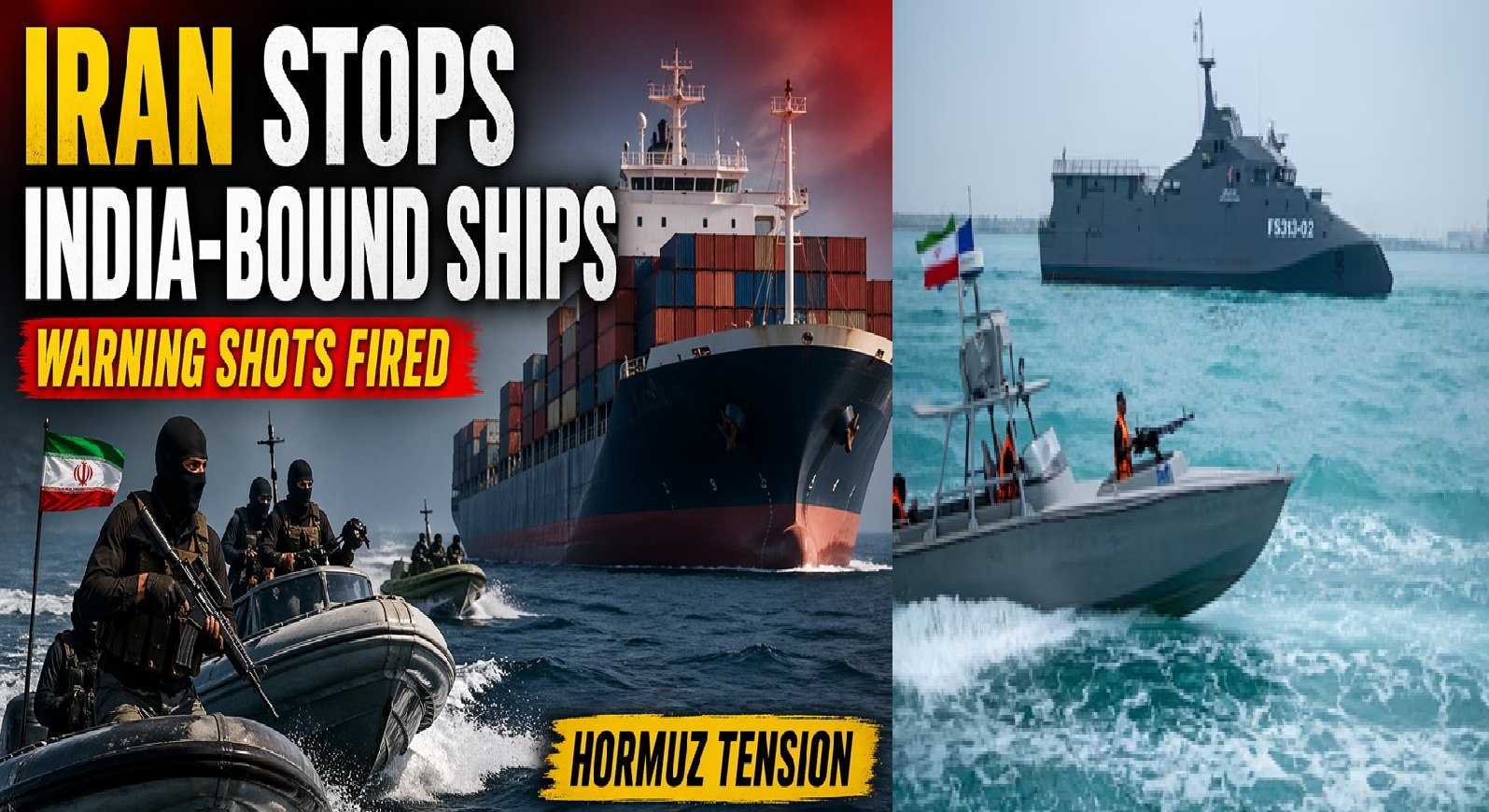
Speedboats, Masks, and Rifles: Iran Intercepts India-Bound Ships in Strait of Hormuz — Shocking Video Surfaces
Speedboats, Masks, and Rifles: Iran Intercepts India-Bound Ships in Strait of Hormuz — Shocking Video Surfaces
Speedboats, Masks, and Rifles: Iran’s Islamic Revolutionary Guard Corps releases dramatic footage of armed interception of ships bound for India in the Strait of Hormuz. Tensions escalate as warning shots are fired.
Speedboats, Masks, and Rifles: Iran’s Dramatic Interception in Hormuz Raises Global Concerns
Amit Kaul – For Digital Desk, Bengaluru: April 23, 2026 – A newly released video by Iran’s powerful military wing, the Islamic Revolutionary Guard Corps (IRGC), has sent shockwaves across global maritime and geopolitical circles. The footage captures a tense and highly coordinated operation in the strategically vital Strait of Hormuz, where Iranian forces intercepted multiple commercial vessels reportedly bound for India.
The video, now circulating widely across international media, shows IRGC personnel in high-speed boats rapidly approaching large cargo ships. Armed with rifles and wearing face masks, the soldiers appear to execute a tactical boarding maneuver, underscoring Iran’s assertive stance over maritime activities in the region.
https://aamnewsnetwork.com/trump-iran-ceasefire-pakistan-shahbaz-munir-role/
What the Video Shows
The visuals depict a dramatic escalation at sea. Several speedboats surround the targeted vessels before armed personnel climb aboard. The ships identified in the footage include Epaminondas and MSC Francesca, both reportedly en route to Indian ports.
According to Iranian state-linked outlet Nour News, warning signals were initially issued to the vessels. However, when the Epaminondas allegedly failed to comply, Iranian forces opened fire to compel it to stop. Another vessel, Euphoria, reportedly halted after similar warning shots were fired.
The presence of masked soldiers carrying rifles has added to the intensity of the visuals, signaling a zero-tolerance approach by Iranian authorities in enforcing maritime regulations.
Speedboats, Masks, and Rifles: Iran’s Justification
In an official statement, the IRGC defended its actions, claiming that the intercepted ships had violated international maritime regulations within Iranian-controlled waters. The MSC Francesca was accused of having links to what Iran described as the “Zionist regime,” a term often used by Iranian authorities in reference to Israel.
Meanwhile, the Epaminondas was alleged to have tampered with its navigation systems, a serious violation that Iran claims could jeopardize maritime safety in the region.
Iran has reiterated that any breach of its maritime security protocols in the Strait of Hormuz constitutes a “red line.” The statement emphasized that such actions would be met with immediate enforcement measures, including interception and, if necessary, use of force.
Strategic Importance of the Strait of Hormuz
The Strait of Hormuz is one of the world’s most critical maritime corridors. Roughly 20% of global oil shipments pass through this narrow waterway, making it a focal point of international trade and energy security.
For India, which relies heavily on energy imports from the Middle East, any disruption in Hormuz has direct economic implications. The interception of India-bound vessels raises concerns about the safety of shipping routes and potential delays in critical supplies.
Speedboats, Masks, and Rifles: Global Reactions and Implications
While there has been no immediate official response from Indian authorities, the development is likely to trigger diplomatic discussions. Shipping companies and international trade bodies are also expected to reassess risk levels in the region.
Experts suggest that Iran’s actions may be part of a broader strategy to assert control over maritime routes amid ongoing geopolitical tensions. The involvement of vessels allegedly linked to sensitive political affiliations adds another layer of complexity to the situation.
The use of force, even as a warning mechanism, could have ripple effects on global shipping insurance costs, freight rates, and overall trade stability in the region.
Rising Maritime Tensions
This incident is not isolated. The Persian Gulf has witnessed multiple confrontations in recent years involving commercial vessels, naval forces, and regional powers. Each such episode heightens the risk of escalation, particularly in a region already fraught with political and military sensitivities.
The IRGC’s decision to release the video publicly may also be a calculated move aimed at sending a strong message to international shipping operators: compliance with Iranian regulations is non-negotiable.
Speedboats, Masks, and Rifles: What Comes Next?
As investigations and diplomatic engagements unfold, the global community will closely monitor developments in the Strait of Hormuz. For India and other nations dependent on this route, ensuring the safety of maritime trade remains a top priority.
The incident underscores the fragile balance in one of the world’s most critical trade arteries. Whether this marks a temporary enforcement action or the beginning of heightened maritime scrutiny by Iran remains to be seen.
https://digitalamitkaul.online/pakistan-blackouts-lng-crisis-hunger-iran-us-talks-plan/
For now, the images of masked soldiers, speeding boats, and armed interceptions serve as a stark reminder of the geopolitical tensions shaping global trade routes today.
Author Bio
Amit Kaul is a professional content writer and digital news strategist based in Bengaluru (India). With over a decade of experience covering transportation, technology, and travel, Amit specializes in creating SEO-optimized, engaging news content for digital platforms. He focuses on in-depth reporting, trend analysis, and reader-friendly storytelling, ensuring articles reach a global audience effectively.



Pingback: America’s Failure and a New Chapter in Hormuz”: Iran’s Supreme Leader Issues Stark Warning to Trump - DNN
Pingback: China Defies US Sanctions on Iranian Oil, Shields Key Refineries in Strategic Countermove - ANN