
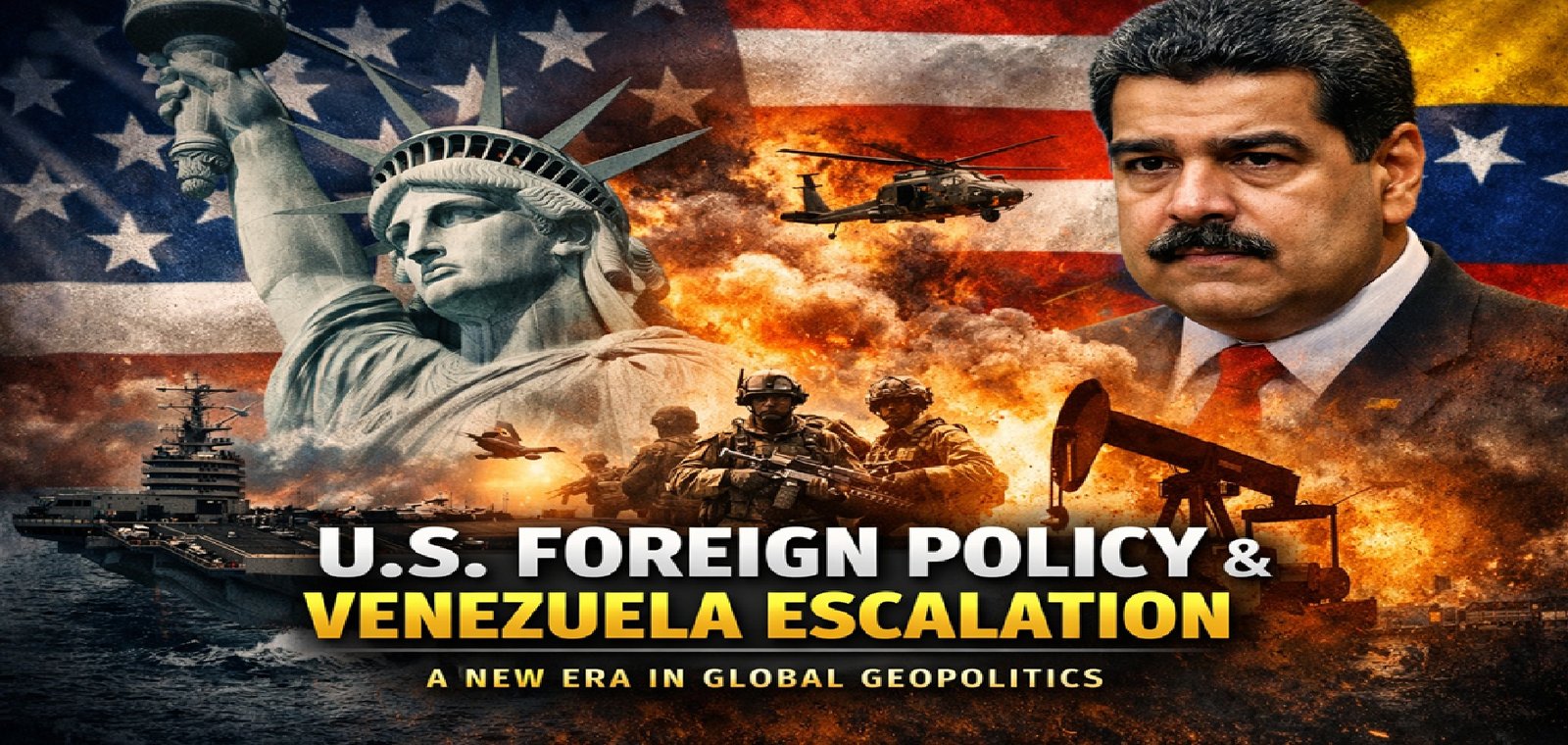
U.S. Foreign Policy and Venezuela Escalation: A Dangerous New Era in Global Geopolitics
U.S. Foreign Policy and Venezuela Escalation: A Dangerous New Era in Global Geopolitics
U.S. Foreign Policy and Venezuela Escalation: Explore how intensified U.S. military actions and foreign policy toward Venezuela in 2026 signal a new geopolitical era, sparking global controversy, regional tension, and profound implications for international law, energy markets, and hemispheric security.
U.S.–Venezuela Escalation: Overview
Amit Kaul – For Digital Desk, Bengaluru: January 9, 2026 – In early January 2026, U.S. foreign policy toward Venezuela escalated dramatically, marking one of the most controversial military engagements in recent memory. The United States launched a unilateral military operation in Venezuela, capturing President Nicolás Maduro and transporting him to the United States on federal charges, including narcotics trafficking, in an action dubbed Operation Absolute Resolve. The move represents a significant shift in Washington’s foreign policy posture and has generated global reactions ranging from strong support to fierce condemnation.
This escalation has reignited debates about international law, hemispheric influence, and the role of military force in pursuing geopolitical objectives. Analysts predict that the ripple effects will likely shape global politics throughout 2026 and beyond.
U.S. Foreign Policy and Venezuela Escalation: The U.S. Military Operation and Its Justification
On January 3, 2026, U.S. special operations forces executed a major military operation in Caracas, resulting in the capture of Venezuelan President Nicolás Maduro and his wife. According to multiple reports, the Trump administration asserted that Maduro’s government was complicit in narco-terrorism and a threat to U.S. national security.
In Washington, senior officials, including Senators and Cabinet members, have defended the action as necessary to dismantle narcotics networks and restore democratic governance in Venezuela. Secretary of State Marco Rubio emphasized that the United States did not intend to govern Venezuela but would pursue structural change, particularly through control over Venezuela’s oil sector.
https://digitalamitkaul.online/israel-syria-us-brokered-military-hotline/
The U.S. also conducted an extended oil blockade and interdiction campaign, known as Operation Southern Spear, involving naval and maritime actions against Venezuelan and sanctioned oil tankers in the Caribbean Sea. Critics argue this strategy goes beyond counter-narcotics and veers into economic coercion.
International Law and Global Reactions
The legality of the U.S. operation has sparked fierce debate. Human rights organizations and international law experts contend that unilateral military intervention without United Nations authorization undermines long-standing global norms. A statement by the Washington Office on Latin America (WOLA) denounced the intervention as a violation of the U.S. Constitution’s war powers limits and international law.
Global responses have been deeply polarized: U.S. Foreign Policy and Venezuela Escalation
Russia and China have strongly condemned the U.S. actions as acts of aggression, with Moscow calling it a “serious violation of sovereignty” and Beijing urging a halt to unilateral sanctions and military pressure.
Latin American leaders voiced mixed reactions: Brazil condemned the bombing and capture of Maduro as crossing “an unacceptable line,” while Argentina praised the fall of Maduro’s regime as positive for freedom.
African political groups have protested U.S. intervention, including demonstrations outside the U.S. Embassy in South Africa, calling for Maduro’s release.
Meanwhile, the United Nations has reiterated that dialogue remains the only viable path to lasting peace and has urged restraint from all parties, reflecting widespread concern about the conflict’s escalation.
Regional and Domestic Implications
Central and South America now face heightened geopolitical uncertainty. Venezuela, historically aligned with Russia, China, and Iran, may see a reconfiguration of regional alliances. Some analysts warn that the intervention could prompt expanded military posturing from external powers or lead to proxy conflicts reminiscent of Cold War dynamics.
Within the United States, the intervention has intensified debates over executive authority and congressional oversight in foreign policy. Critics argue that Congress was bypassed, setting a precedent with far-reaching consequences for U.S. engagement abroad. Supporters maintain that decisive action was needed to counter authoritarianism and transnational crime.
U.S. Foreign Policy and Venezuela Escalation: Economic and Energy Sector Impact
Venezuela possesses the world’s largest proven oil reserves, making it a pivotal player in global energy markets. The U.S. strategy includes plans to leverage these reserves to influence global oil prices and secure energy dominance. According to reports, the Trump administration aims to push Venezuela’s crude production higher and ultimately use its oil to lower domestic U.S. fuel costs.
Energy markets have responded cautiously. While immediate price swings have been modest, analysts warn that longer-term volatility could emerge as markets price in geopolitical risk and uncertainty over production capacity and infrastructure rehabilitation.
The insurance and financial sectors are also bracing for wider political risk, as multinational firms reassess their exposure in Latin America and beyond, anticipating potential spillovers from the crisis.
https://aamnewsnetwork.com/us-military-captures-venezuelan-president-nicolas-maduro/
What Comes Next
As 2026 unfolds, the U.S.–Venezuela crisis is likely to remain a defining geopolitical flashpoint. Key variables include:
- Diplomatic engagement with international bodies and regional actors
- Reconstruction of Venezuela’s political institutions and oil infrastructure
- Potential reactions from Russia, China, and other powers
- Legal challenges and international judicial proceedings
The international community’s response will shape whether this episode marks a new era of assertive U.S. foreign policy or a cautionary example of interventionist overreach. The world is watching closely.
Author Bio
Amit Kaul is a professional content writer and digital news strategist based in , Bengaluru. With over a decade of experience covering transportation, technology, and travel, Amit specializes in creating SEO-optimized, engaging news content for digital platforms. He focuses on in-depth reporting, trend analysis, and reader-friendly storytelling, ensuring articles reach a global audience effectively.



Pingback: Trump Claims He Prevented India-Pakistan War – Nobel Peace Prize Aspirations Spark Debate - ANN