IMF Warns Venezuela’s Economy and Humanitarian Situation Remain “Quite Fragile”
IMF Warns Venezuela’s Economy and Humanitarian Situation Remain “Quite Fragile”
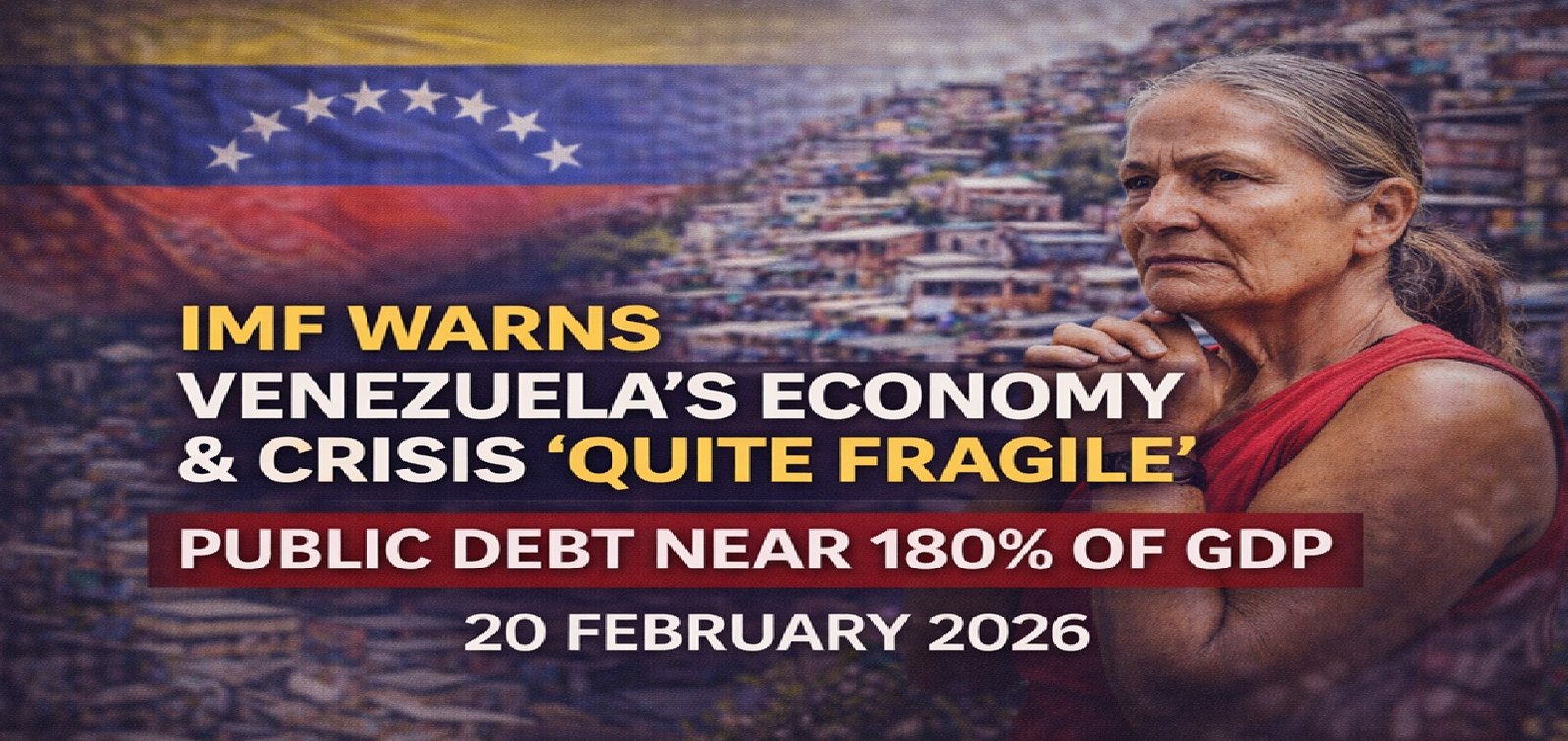
The IMF warns that Venezuela is in deep economic and humanitarian distress, with public debt near 180% of GDP, triple-digit inflation, and mass emigration — highlighting risks to growth and social stability.
Amit Kaul – For Digital Desk, Bengaluru: February 19, 2026 – The International Monetary Fund (IMF) has issued a blunt warning about the economic and humanitarian crisis gripping Venezuela, describing the situation as “quite fragile” and underscoring the extraordinary challenges facing the country’s finances and social systems. The alert comes amid centuries-high inflation, a collapsing currency, and a debt load that now looms at nearly 180 percent of gross domestic product (GDP) before accounting for legal or arbitration judgments from past defaults.
IMF spokeswoman Julie Kozack delivered the assessment during a briefing earlier this week, emphasizing that Venezuela’s socioeconomic conditions remain highly strained. Despite not having formal economic relations with Caracas since 2019, the IMF continues to monitor developments and consult with member countries on possible future engagement.
https://digitalamitkaul.online/global-news-roundup-16-february-2026/
IMF Warns: Historic Crisis in Numbers
Venezuela’s economic deterioration has been extensive and prolonged. Once among Latin America’s wealthiest oil-rich nations, it has endured decades of economic mismanagement, political instability, and external sanctions. IMF data show that inflation in the country is currently estimated to be in the triple digits, and the bolívar continues to lose value rapidly against major currencies.
The IMF’s 180 percent debt-to-GDP ratio places Venezuela among the world’s most indebted nations, particularly when considering that much of this debt is in default. Structural economic contraction and recurrent crises have eroded the country’s capacity to generate revenue or service obligations, limiting access to new financing.
Humanitarian Squeeze: Poverty, Shortages, and Emigration
Beyond macroeconomic statistics, Venezuela’s crisis has had a profound social impact. Since 2014, roughly a quarter of the nation’s population — nearly 8 million people — has left the country in search of opportunities and stability abroad, making it one of the largest displacement crises in recent Latin American history. Poverty remains widespread, basic public services are strained, and inequality levels are high.
The IMF warns that shortages of essentials, including healthcare, food, and reliable utilities, continue to inconvenience households nationwide. Such conditions, experts say, are both a symptom and a driver of economic instability, as reduced productivity and consumer confidence further depress economic activity.
Humanitarian organizations, including international relief groups, have repeatedly called attention to Venezuela’s needs, estimating that millions require some form of assistance to remain above subsistence. This includes food security programs, safe water access, and medical care — all of which have struggled to keep pace with demand amid funding shortfalls.
IMF Warns: IMF’s Past and Potential Future Engagement
Venezuela has been in a unique position in IMF records because formal relations were essentially paused more than half a decade ago. Recognition issues surrounding the country’s leadership have complicated engagement, and without official IMF surveillance or capacity-building work, the Fund’s role has been largely observational rather than operational.
However, IMF Managing Director Kristalina Georgieva and U.S. Treasury officials have continued broader strategic dialogue about Venezuela’s macroeconomic situation, signaling international interest in possible future cooperation — albeit contingent on political and institutional clarity.
Under current statutes, the IMF cannot provide financial assistance without established diplomatic relations and member consensus. Should these conditions evolve, Venezuela could potentially regain access to roughly $4.9 billion in Special Drawing Rights (SDRs) that have remained frozen since 2019.
SDRs represent international reserve assets that can improve liquidity and assist balance-of-payments support for IMF members. In Venezuela’s case, the restoration of these funds could provide an important cushion for economic stabilization — although the scale of the broader crisis suggests that much more comprehensive interventions would be required.
Debt Overhang and Structural Challenges
Venezuela’s high debt ratio reflects both accumulated defaults and rapid currency decline. According to economic analysts, restructuring or significant debt reduction would be essential for restoring access to international funding and investor confidence. Many economists argue that even large reductions (often called “haircuts”) on principal and interest would be needed to normalize financial flows.
Much of Venezuela’s debt is tied to external bondholders, arbitration claims from expropriated firms, and bilateral loans from countries like China and Russia. This complex web complicates unified restructuring efforts and often requires coordination among diverse creditor groups, each with differing priorities and legal constraints.
Public debt at 180 percent of GDP far exceeds what most global economic guidelines regard as sustainable. For comparison, many advanced economies consider debt levels of 60 percent to 100 percent as manageable, though context matters significantly. Venezuela’s lack of diversified revenue streams, heavy reliance on oil exports, and deteriorated infrastructure exacerbate the debt burden.
IMF Warns: Broader Regional and Global Implications
The IMF’s warning is significant not just for Venezuela, but for regional economic stability. A struggling Venezuelan economy affects neighboring countries through migration flows, remittances, and cross-border trade dynamics. Nations such as Colombia, Peru, and Brazil have absorbed large numbers of Venezuelan migrants, straining public services and social support systems.
Additionally, energy markets — traditionally tied to Venezuela’s status as an OPEC member with vast oil reserves — remain sensitive to the country’s production levels. Although current output remains far below historic peaks, any substantial shift in policy or stabilization could influence crude supply forecasts and regional energy pricing.
Financial markets also watch indicators like inflation and debt ratios for signs of contagion risk in emerging markets. Countries with similarly high public debt or limited fiscal space often face heightened investor caution, particularly in times of global uncertainty.
Outlook: Fragile but Watchful
The IMF’s characterization of Venezuela’s situation as “quite fragile” underscores both the severity of current circumstances and the complexities ahead. Without substantial economic reforms, debt restructuring, and political consensus, the country’s recovery trajectory remains uncertain.
https://aamnewsnetwork.com/global-news-roundup-17-february-2026/
For now, the situation hinges on several factors:
- Political and institutional recognition that would allow the IMF to re-establish formal relations and provide support
- Debt restructuring negotiations that address sustainability and creditor coordination
- Inflation control measures to stabilize the currency and restore purchasing power
- Humanitarian interventions to address immediate social needs and rebuild basic services
Author Bio
Amit Kaul is a professional content writer and digital news strategist based in Bengaluru (India). With over a decade of experience covering transportation, technology, and travel, Amit specializes in creating SEO-optimized, engaging news content for digital platforms. He focuses on in-depth reporting, trend analysis, and reader-friendly storytelling, ensuring articles reach a global audience effectively.