
Russia and Iran Seal 20-Year Strategic Pact, Redrawing Global Power Lines
Russia and Iran Seal 20-Year Strategic Pact, Redrawing Global Power Lines
Russia and Iran Seal 20-Year Strategic Pact: Russia and Iran have formalized a sweeping 20-year Comprehensive Strategic Partnership, deepening economic, defense, and geopolitical collaboration. The pact reshapes regional alliances and challenges Western influence.
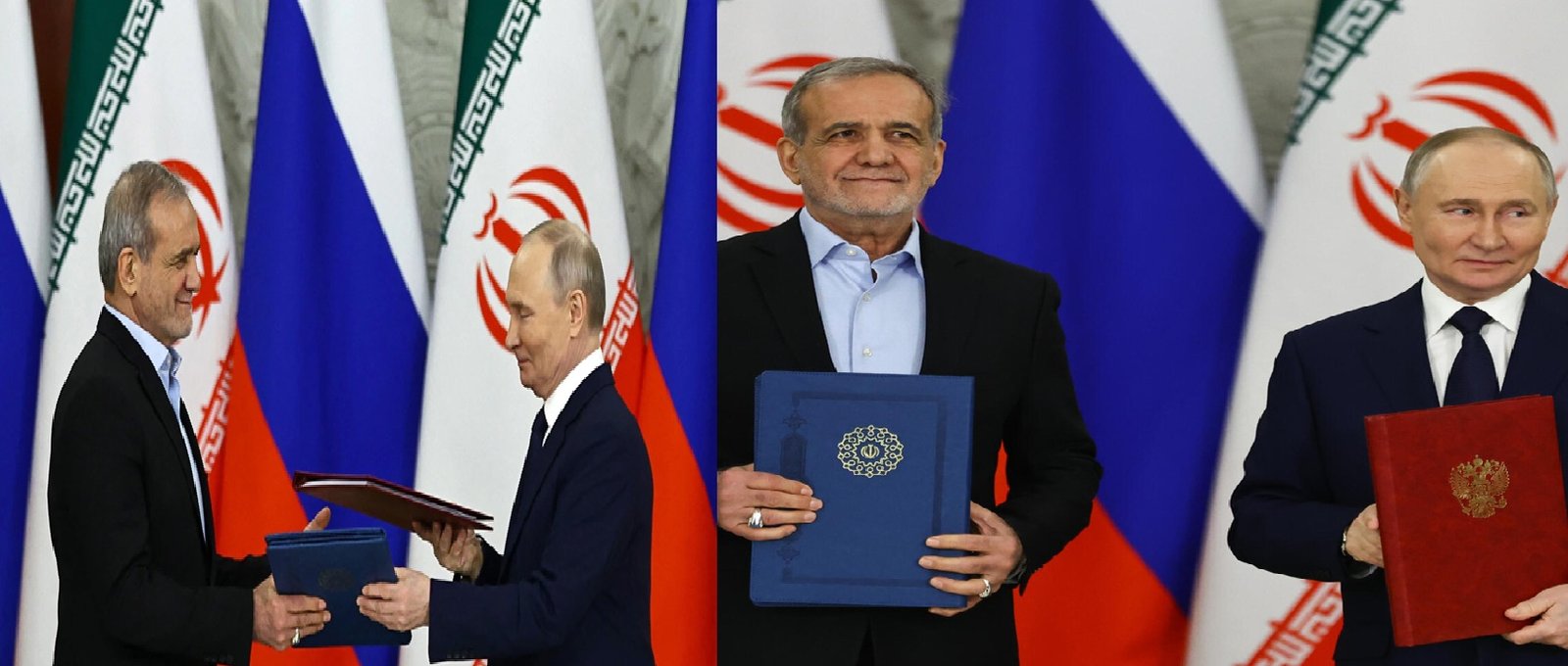
Amit Kaul – For Digital Desk, Bengaluru: January 17, 2026 – Russia and Iran have entered a landmark phase in their bilateral relations after signing and activating a 20-year Comprehensive Strategic Partnership Treaty, a move that is generating global geopolitical reverberations and reshaping power dynamics in Eurasia and the Middle East. The long-term agreement, signed in Moscow on January 17, 2025, by Russian President Vladimir Putin and Iranian President Masoud Pezeshkian, has now come into effect following legislative ratification in both capitals.
The strategic partnership — designed to govern relations for the next two decades — aims to deepen cooperation across a broad spectrum of spheres, encompassing defense, security, energy, transportation, finance, culture, technological exchange, and counterterrorism efforts. The expansive nature of the treaty, which covers 47 articles, signals a decisive step toward a more aligned Russia-Iran axis at a time of heightened global tensions and rising geopolitical competition.
https://digitalamitkaul.online/trump-tough-stance-iran-protest-crackdown-global-reaction/
A New Era of Bilateral Cooperation
Analysts have characterized the agreement as a pivot toward a strategic alliance designed to mitigate the impact of Western sanctions and expand bilateral economic exchange and political coordination. Both Russia and Iran have faced sustained international pressure and financial restrictions — Moscow due to its ongoing conflict in Ukraine, and Tehran as a result of longstanding disputes over its nuclear program and regional policies. By institutionalizing cooperation in areas such as trade, energy, and intelligence sharing, the treaty reflects a shared interest in forging an autonomous geopolitical path.
One notable provision in the treaty is the pledge that neither party will allow foreign territories to be used as staging grounds by hostile actors seeking to undermine the security of the other. This clause underscores a strategic commitment to mutual support in defense and counter-external threats, albeit without constituting a full mutual defense clause akin to those found in formal military alliances.
Russia and Iran Seal 20-Year Strategic Pact: Defense, Technology, and Transport Integration
While the pact stops short of creating a formal military alliance, it does provide a framework for extensive defense cooperation, joint military exercises, intelligence coordination, and military-technical collaboration. The treaty’s defense component also facilitates expanded training programs, joint staff engagements, and the potential for coordinated stances at international security forums.
Economic ties also feature prominently. The partnership encourages coordinated development in strategic sectors, including energy infrastructure, transportation projects, and digital technology cooperation. Notably, both countries have expressed interest in accelerating the International North-South Transport Corridor (INSTC), a multimodal network that includes rail, road, and maritime routes linking Russia, Iran, and beyond. This transport corridor could reduce transit times between northern Europe and Southern Asia, creating new avenues for commerce while diminishing reliance on Western trade routes.
In the energy sector, the agreement dovetails with recent cooperation initiatives between Russian energy firms and Iranian counterparts, including discussions around gas pipelines and nuclear energy projects. Russia has also advanced multiple nuclear-related agreements with Iran, contributing expertise and infrastructure support as Tehran seeks to expand its civilian nuclear capacity.
Geopolitical Implications
The pact underscores how both Moscow and Tehran are positioning themselves politically to navigate the shifting global landscape. For Russia, the agreement reinforces its regional influence and underscores its intent to sustain strategic partnerships independent of Western diplomatic frameworks. For Iran, the treaty offers a measure of economic and diplomatic support that counters international isolation, providing a platform for sustained collaboration across key industries and political arenas.
However, the treaty has sparked debate among global policymakers. Critics argue that strengthening Russia-Iran ties could further complicate efforts to resolve conflicts in Syria, Yemen, and other flashpoints where both actors wield influence. Additionally, Western governments have expressed concern that closer Russian-Iranian alignment could embolden Tehran’s regional policies at a time when negotiations over its nuclear program remain stalled.
Meanwhile, Russia has emphasized its readiness to engage diplomatically with other regional parties to mitigate escalating tensions. Recent communications include dialogues involving Israeli leadership as Moscow positions itself as a mediator amid security concerns in the Middle East.
Russia and Iran Seal 20-Year Strategic Pact: Economic and Regional Shifts
Economically, the partnership enables more coordinated approaches to trade and finance, including cooperation in banking and investment. Both nations have signaled interest in establishing alternative payment mechanisms and reducing dependency on Western financial systems. The pact also fosters enhanced collaboration in technology and cybersecurity, reflecting shared priorities in digital resilience and innovation outside dominant Western ecosystems.
Regionally, the agreement may encourage other nations to reassess their own diplomatic strategies. For instance, Turkey, India, and Gulf States may weigh opportunities for engagement or risk recalibration as Russia-Iran cooperation takes shape. The treaty’s effect on regional security architectures remains a subject of intensive analysis among foreign policy experts.
https://aamnewsnetwork.com/indian-embassy-iran-urges-nationals-leave-unrest-2026/
Looking Ahead
As the Comprehensive Strategic Partnership Treaty begins to be implemented, both governments are expected to hold high-level dialogues to operationalize specific projects and directives articulated in the agreement. Whether the 20-year pact will fundamentally reshape Eurasian geopolitics or merely formalize existing alignments remains a key question for observers in Washington, Beijing, and capitals across the Middle East. What is clear is that the Russia-Iran axis has transitioned into a new phase of institutionalized cooperation that will play a consequential role in global strategic affairs in the years ahead.
Author Bio
Amit Kaul is a professional content writer and digital news strategist based in Bengaluru (India). With over a decade of experience covering transportation, technology, and travel, Amit specializes in creating SEO-optimized, engaging news content for digital platforms. He focuses on in-depth reporting, trend analysis, and reader-friendly storytelling, ensuring articles reach a global audience effectively.