
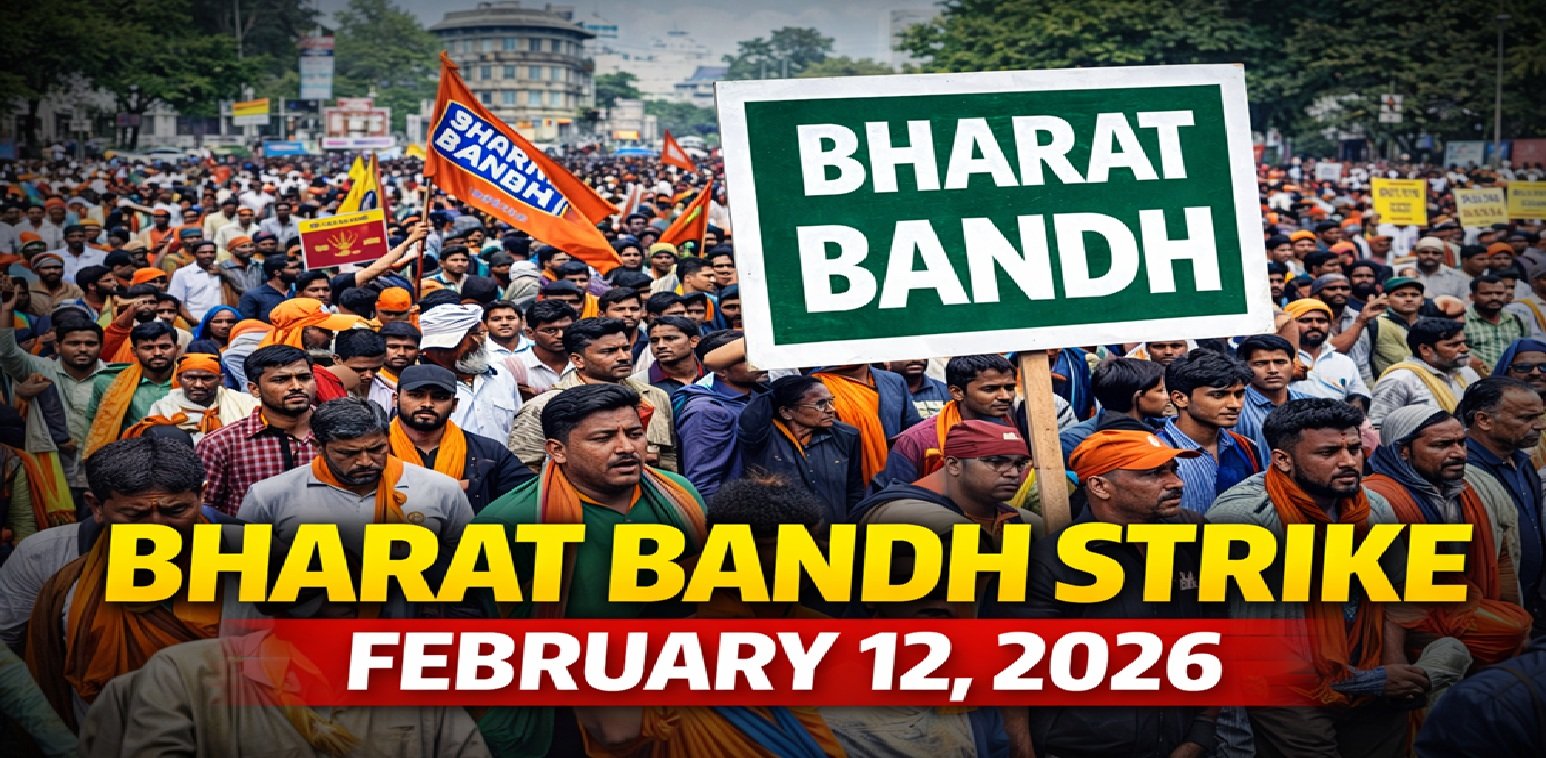
India Witnesses Nationwide Bharat Bandh Strike Over Labour Laws
India Witnesses Nationwide Bharat Bandh Strike Over Labour Laws
India Witnesses Nationwide Bharat Bandh Strike: On February 12, 2026, a nationwide Bharat Bandh brought India’s transport, banking, and services to a standstill as trade unions and farmers protested controversial new labour codes and government policies, mobilising millions of workers across states.
Amit Kaul – For Digital Desk, Bengaluru: February 12, 2026 – India was engulfed in a massive nationwide Bharat Bandh on Thursday, February 12, 2026, as more than 30 crore workers joined a general strike called by central trade unions and farmers’ organisations to protest the government’s new labour laws and other policy changes. The widespread shutdown disrupted transport services, banks, markets, government offices, and schools in many parts of the country, reflecting deep public frustration with labour reforms and economic policy direction.
The strike, which began early Thursday morning and was set to continue throughout the day, saw active participation from over ten major trade unions, including the International Trade Union Congress (INTUC), All India Trade Union Congress (AITUC), Centre of Indian Trade Unions (CITU), and others. Farmers’ groups such as the Samyukt Kisan Morcha (SKM) also backed the action, contributing to its nationwide scale.
https://digitalamitkaul.online/nia-raids-kerala-pfi-case/
India Witnesses Nationwide Bharat Bandh Strike: Why the Bharat Bandh Was Called
Trade unions have framed the Bharat Bandh as a protest against the government’s four new labour codes, which came into effect in late 2025 and replaced 29 existing labour laws. According to union leaders, these codes weaken worker protections, reduce job security, and make it easier for employers to hire and fire staff. They argue that the reforms favour employers over workers and diminish workers’ ability to organise and bargain collectively.
In addition to labour code concerns, participating unions and farmers’ groups listed multiple demands, including:
- Repeal of the four labour codes
- Restoration of the old pension scheme
- Implementation of guaranteed minimum wages
- Withdrawal of controversial bills such as the Draft Seed Bill and the Electricity Amendment Bill
- Opposition to recent trade policies is perceived as threatening to agriculture and small producers
The scale of mobilization for the Bharat Bandh is historic: union leaders estimated that nearly 30 crore workers joined the action across India, representing tens of millions of employees from both the organised and unorganised sectors.
India Witnesses Nationwide Bharat Bandh Strike: Widespread Disruptions Across States
The strike’s impact varied across states, with some regions experiencing near-total shutdowns while others saw only partial disruptions. States such as Odisha and Assam were reported to be completely shut down, while services in Kerala, Tamil Nadu, West Bengal, Odisha, Karnataka, and Bihar were significantly affected by closures and slowdowns.
India Witnesses Nationwide Bharat Bandh Strike: Transport and Travel Chaos
Public transport was among the hardest hit:
- Many state buses, taxis, and local transit services operated on limited schedules or remained suspended in parts of Southern and Eastern India.
- Road traffic in key cities was light in some areas due to protests and picketing, resulting in blocked roads and slow commute times.
- Travel advisories were issued by authorities urging commuters to plan and avoid non-essential travel.
Banking and Services Impacted
Public sector banks and financial institutions reported limited services or branch closures as bank employees also supported the strike call. A coalition of banking unions, including AIBEA, AIBOA, and BEFI, joined the Bharat Bandh, leading to disruptions in cash transactions, cheque clearances, and routine branch operations in several regions.
Government offices, markets, and small businesses in many states either shut down or operated with reduced staff levels due to staff participation in the strike or transport difficulties. Although schools and colleges were not officially declared closed nationwide, local closures were reported where conditions made attendance difficult or unsafe.
India Witnesses Nationwide Bharat Bandh Strike: Essential Services and Exemptions
Despite the shutdown, authorities and union organisers made efforts to ensure that essential services such as hospitals, emergency medical care, ambulance services, electricity, water supply, and firefighting continued unhindered. Airports and critical infrastructure also remained operational to avoid jeopardising public safety.
Political Responses and Public Opinion
The strike intensified political debate nationwide. Opposition leaders and labour activists welcomed the Bharat Bandh as a legitimate expression of worker frustration, while government officials emphasised law and order, urging peaceful protest and highlighting citizens’ constitutional right to strike under certain conditions.
Some public voices expressed mixed reactions to the bandh’s disruption. In urban centres like Bengaluru, residents reported uneven participation — with some areas experiencing minimal impact and others seeing significant slowdowns in services — reflecting diverse economic realities and differing levels of union influence across states.
Economic and Social Implications
Industry analysts say that while one-day strikes like the Bharat Bandh may not have long-lasting economic consequences, they do highlight growing worker concerns about job security, wage stagnation, and social safety nets. Labour economists suggest that repeated large-scale protests could influence future policy discussions and electoral politics if underlying grievances are not addressed.
The participation of farmers’ organisations in the strike also points to the increasing convergence of worker and agricultural discontent in India’s political landscape — a dynamic that could have implications for rural development policy and agricultural reform.
https://aamnewsnetwork.com/supreme-court-stays-ugc-caste-regulation-rules/
India Witnesses Nationwide Bharat Bandh Strike: Looking Ahead
As the Bharat Bandh concluded on February 12, attention shifted to follow-up talks between union leaders and government representatives. Union leaders have signalled that if their core demands are not addressed, further protests and actions could follow — including the possibility of prolonged or indefinite strike campaigns.
For now, the strike remains a significant marker of worker and farmer frustration in India’s evolving economic policy context. Its impact on daily life, public services, and political discourse reflects broader tensions over labour rights, economic reforms, and the future direction of governance in the world’s largest democracy.
Author Bio
Amit Kaul is a professional content writer and digital news strategist based in Bengaluru (India). With over a decade of experience covering transportation, technology, and travel, Amit specializes in creating SEO-optimized, engaging news content for digital platforms. He focuses on in-depth reporting, trend analysis, and reader-friendly storytelling, ensuring articles reach a global audience effectively.



Pingback: India’s Bharat Bandh Disrupts Transport Across Key States - DNN
Pingback: Terrorist Neutralized in Jammu and Kashmir’s Kishtwar District; Security Forces Intensify Anti-Terror Operations - ANN